


1. Selection of Power Density by Room Type
The main design parameter is power density (W/m²). It depends on the building’s thermal insulation and the target temperature. It is important to remember that due to direct infrared radiation, the feeling of thermal comfort is achieved at an air temperature 3–4 °C lower than in traditional heating systems.
Power density indicates how much thermal energy must be supplied per square meter of area to compensate for heat losses in the room. The poorer the building insulation, the higher the heat losses and, accordingly, the higher the required power density of infrared heating.

At the preliminary stage of calculating an infrared heating system, this parameter allows you to determine the total power of the heaters and their required quantity.
| Insulation Level | 13°C | 16°C | 19°C |
|---|---|---|---|
| Good | 60 W/m² | 80 W/m² | 100 W/m² |
| Poor | 90 W/m² | 120 W/m² | 150 W/m² |
| No insulation | 200 W/m² | 230 W/m² | 260 W/m² |
| Semi-open area | 230 W/m² | 280 W/m² | 330 W/m² |
2. Installation Rules and Coverage Area
For uniform heating, infrared emitters are installed at a height of 2.5–3.5 m. The effective heating area of a single unit significantly depends on the mounting method (wall or ceiling installation) and the suspension height.
When positioning heaters, it is important to ensure uniform overlapping of radiation zones. This helps to avoid areas with insufficient or excessive heating and provides stable thermal comfort throughout the entire room.

Infrared heaters can be mounted on walls or suspended from the ceiling. The choice of installation method depends on the room structure, ceiling height, and the configuration of working areas.
Wall mounting is typically used in rooms with limited width or when it is necessary to direct heat to a specific area. Ceiling mounting allows for a more even distribution of thermal radiation across the space and is commonly used in industrial and warehouse facilities.
| Mounting Method | Height 2.5 m | Height 3.0 m | Height 3.5 m |
|---|---|---|---|
| Wall-mounted | 8 m² | 20 m² | 40 m² |
| Ceiling-mounted | 17 m² | 24 m² | 32 m² |
3. Example Calculation and Layout Scheme
The calculation of an infrared heating system is carried out in several stages. First, the room area and its level of thermal insulation are determined. Then, based on the table, the required power density is selected, after which the total thermal power of the system is calculated. The resulting power is divided by the power of a single heater, which allows determining the required number of units. After that, a layout scheme is developed, taking into account the coverage area of each heater and the configuration of the room.
Accordingly, the total required heating power is:
As a heat source, six infrared heaters of the ECL-1000 series, each with a capacity of 1 kW, can be used.
With wall-mounted installation at a height of 3 m, one heater effectively covers approximately 20 m² of area. To achieve uniform heat radiation density, the units are distributed around the perimeter of the room.
For uniform heating, it is important not only to determine the number of heaters but also to properly organize their placement. In a room measuring 10 × 5 m, the optimal solution is to install three units along each long wall. The distance between the centers of the heaters is typically about 3–3.5 m.
With this arrangement, the radiation zones of adjacent heaters partially overlap. The intersection of heat flows at approximately the height where people are present allows creating a uniform thermal field and avoiding areas with insufficient heating.
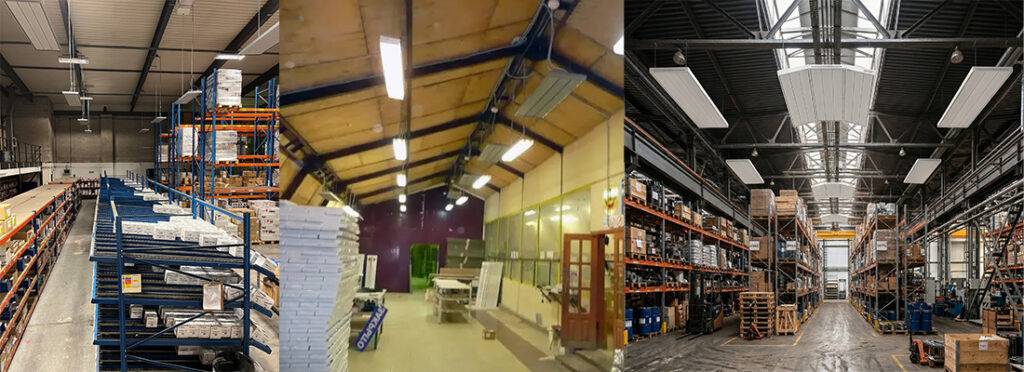
In industrial premises, it is also advisable to take into account the location of working areas. If the main workstations are located in the central part of the workshop, the heaters can be oriented at a slight angle from the walls toward the center of the room. This allows directing the main heat flow to the area where personnel are present.
In addition, the heaters can be divided into two electrical groups of three units each. This configuration allows using only part of the installed capacity during the off-season, providing more flexible control of the heating system operation.