


1. Introduction: What Is Infrared Radiation?
Infrared radiation — what exactly is it? Dangerous radiation (radiation?!) that must be avoided at all costs, or a natural phenomenon without which life on Earth would be impossible? A part of sunlight or a separate type of electromagnetic waves? To understand this, we need to recall a bit from the school physics course — and just a little biology.
Infrared radiation (IR radiation) is a type of electromagnetic wave located in the spectrum immediately beyond the red part of visible light. The human eye cannot perceive it, but our body feels it as heat. That is why infrared waves are often called thermal radiation.
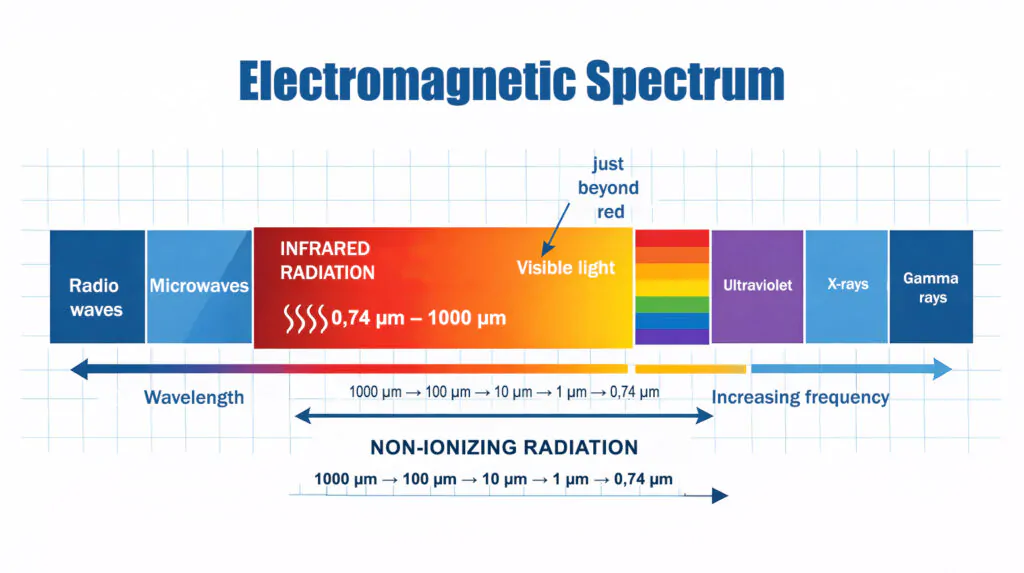
From a physics perspective, infrared radiation is a direct energy transfer mechanism from a source to an object. This feature makes it extremely important for modern heating systems. Unlike convection heating, where the air is heated first and only then the objects, infrared radiation transfers energy directly to surfaces. As a result, heat transfer efficiency increases, energy losses decrease, and warmth is felt faster.
- Residential heating systems
- Local heating
- Technological processes
- Controlled industrial heating
In the context of energy efficiency, infrared technologies are considered one of the most rational methods of heat transfer, since energy is not “dissolved” in the air but is directly absorbed by objects.
2. Discovery History: William Herschel’s Experiment
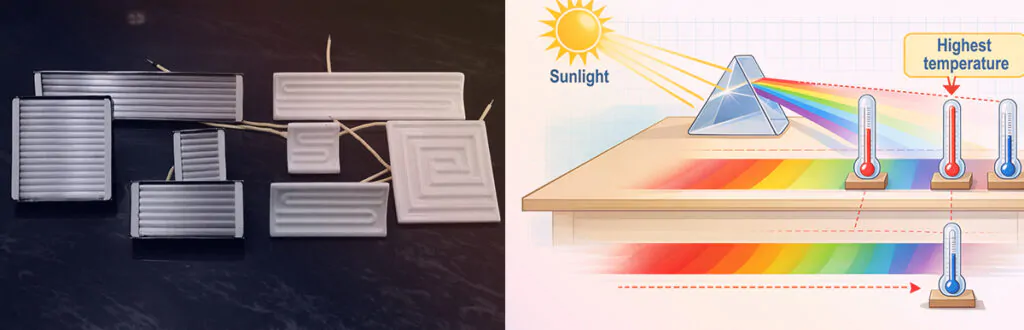
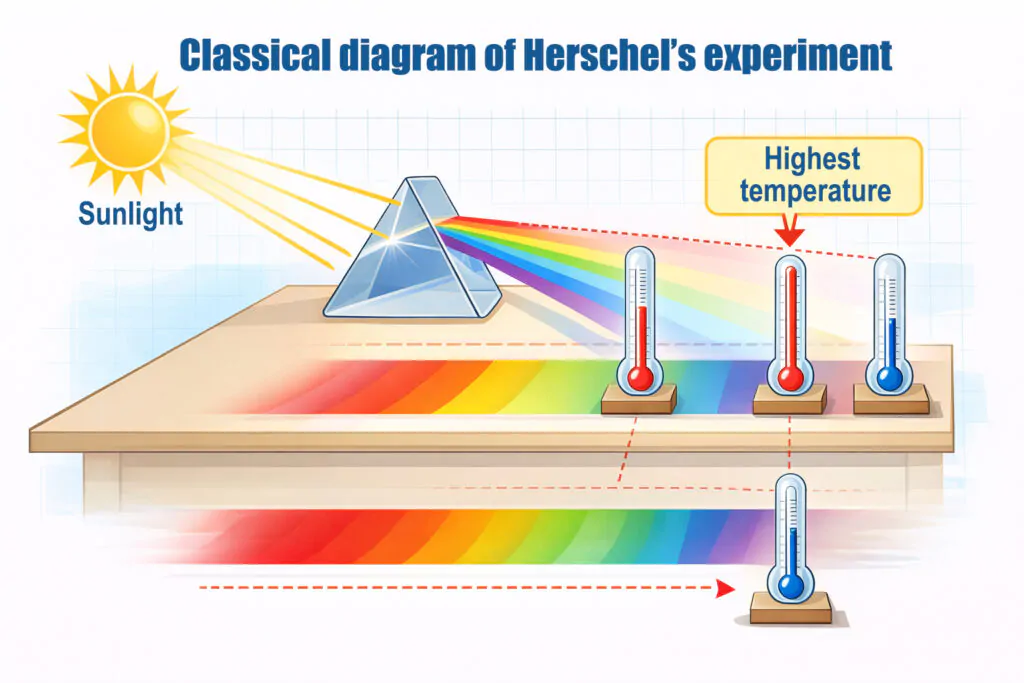
Let us begin with the discovery. Infrared radiation was discovered in 1800 by the English scientist William Herschel. While studying the Sun’s spectrum obtained using a prism, Herschel placed several thermometers in different colored regions of the spectrum.
This meant that beyond red light there exists invisible radiation capable of transferring energy. Thus, a new part of the electromagnetic spectrum was discovered. Further studies proved that this radiation obeys the same laws of optics as visible light: it can reflect, refract, and be absorbed. Therefore, infrared waves have the same physical nature as light waves.
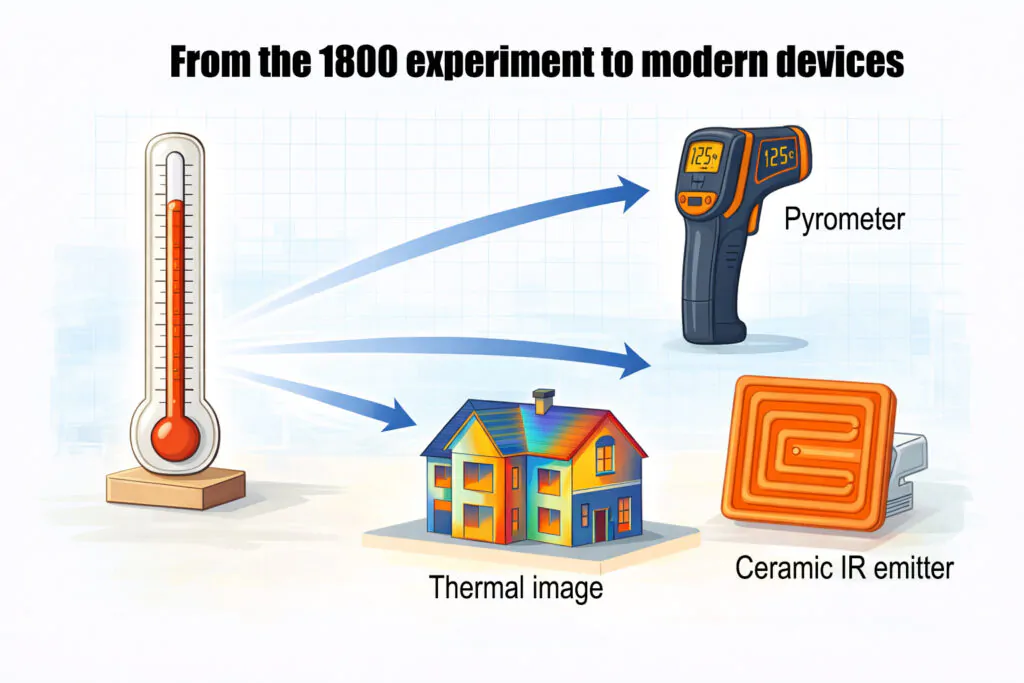
Herschel’s experiment laid the foundation for the development of:
- Non-contact temperature measurement methods
- Modern pyrometers (IR thermometers)
- Thermal imaging cameras
- Industrial infrared emitters
Today, the principle discovered more than two hundred years ago is used in energy, metallurgy, mechanical engineering, and temperature control systems.
3. The Unified Nature of Electromagnetic Waves
123 years after the discovery of infrared radiation, Soviet physicist Alexandra Glagoleva-Arkadieva generated electromagnetic waves with a wavelength of approximately 80 µm, that is, within the infrared range. This became important confirmation that light, infrared rays, and radio waves share a common physical nature — all of them are types of electromagnetic waves.
Unlike radio waves, which mostly pass through materials or reflect from them, infrared radiation has a wavelength ideally suited for interaction with the molecular structure of substances — water, plastic, wood, fabric, and metal surfaces.
Under the influence of IR waves, molecules begin to vibrate more intensely, which manifests itself as heating. That is why infrared radiation transfers heat so quickly and ensures high heat transfer efficiency.
This feature explains why infrared radiation is widely used in heating systems and industrial heating processes: energy is not merely spread through space but is directly absorbed by materials.
4. Wavelength, Temperature, and the Type of Infrared Heater
Infrared radiation occupies a region of the electromagnetic spectrum with wavelengths ranging from 0.74 µm to 100 µm. From a practical standpoint, for heating systems and industrial heating, not only the concept of wavelength itself is important, but also its relationship to the temperature of the heating element.
Short-wave (0.74–2.5 µm)
- Element temperature: above 800–1000°C.
- Sources: quartz and halogen lamps.
- Provide rapid, intensive heating.
- Applications: drying chambers, production lines.
Medium-wave (2.5–50 µm)
- Element temperature: 300–800°C.
- A universal option for manufacturing.
- Ceramic infrared emitters.
- Stable heat flow.
Long-wave (50–100 µm)
- Low-temperature surfaces (up to 300°C).
- Primarily panel heaters.
- Soft heat for residential and office spaces.
Why Is IR Radiation Called “Thermal”?
All bodies heated above absolute zero emit infrared waves. The wavelength depends on temperature — the higher the temperature, the shorter the wavelength. This relationship is described by Wien’s displacement law:
b — Wien’s constant (≈ 2.9 × 10⁻³ m·K)
T — absolute temperature in Kelvin
Thus, the wavelength of a heater is directly determined by the temperature of its surface. When radiation reaches an object, it does not heat the air but is absorbed by the surface. The molecules of the material begin to vibrate more intensely — and the temperature rises.
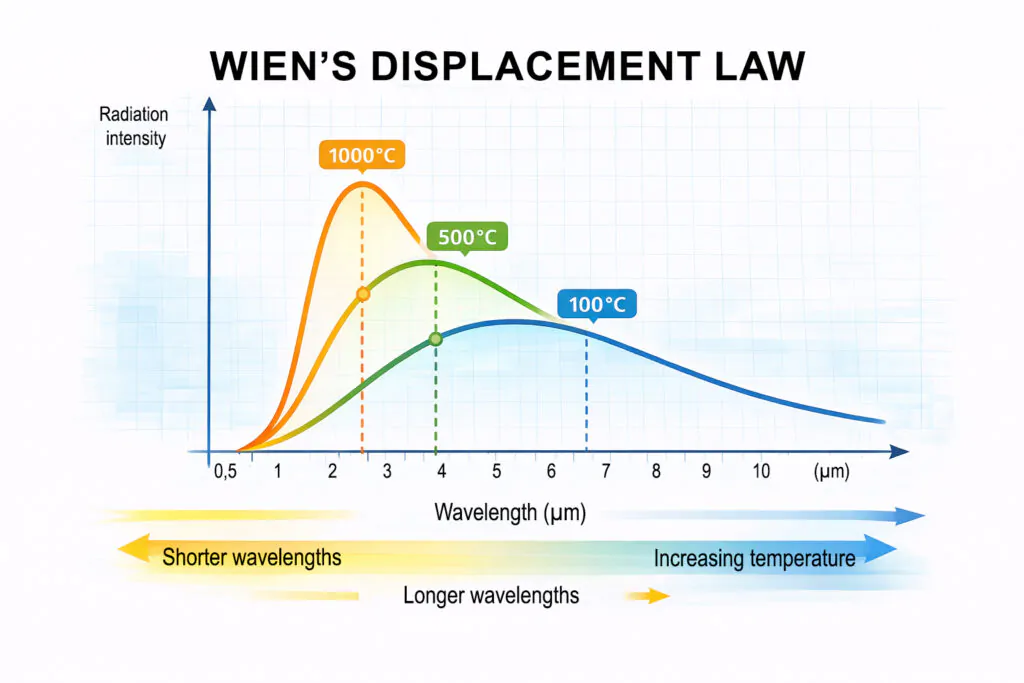
This physical principle forms the basis for selecting an infrared heater for a specific application.
5. Applications in Heating: Light and Dark Infrared Emitters
When selecting an infrared heater, the question often arises: what does a “light” or “dark” emitter mean? In fact, this does not refer to different technologies, but to different temperatures of the heating element and the corresponding wavelength of the heater.
Light Infrared Heaters
They operate at high temperatures and have a shorter wavelength. Their element may visibly glow (red or orange glow). They are used where rapid start-up and high heat flux density are required:
- Plastic thermoforming
- Coating drying
- Short heating cycles
- Local heating
Dark Infrared Heaters
They operate at lower temperatures, do not produce bright visible glow, and generate a softer and more uniform heat flow. They are suitable where stability and the absence of glare are important:
- Drying chambers
- Conveyor lines
- Painting zones
- Workshop heating
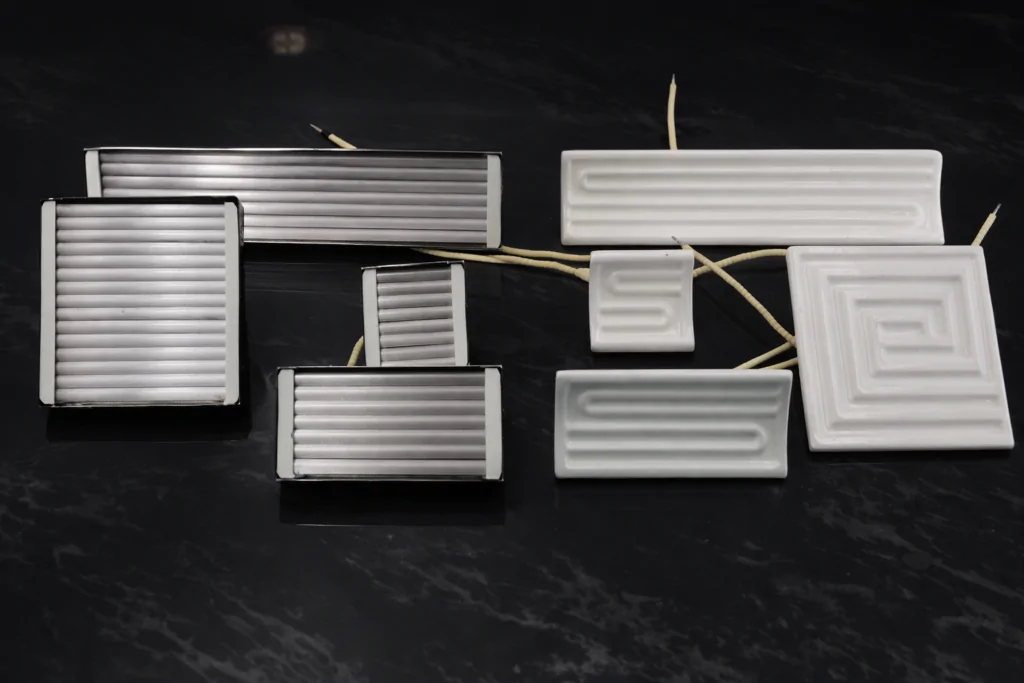
Dark and ceramic infrared emitters are often used in manufacturing due to their high heat transfer efficiency and the ability to precisely control temperature.
6. The Sun — the Most Powerful Source of Heat
The most well-known infrared emitter is, of course, the Sun. Without its energy, life on Earth would be impossible. Even at a distance of approximately 147.5 million km, the Sun efficiently transfers energy through the vacuum of outer space.
It is important to understand: space itself does not heat up. In a vacuum, there is no air, and therefore convection is impossible. However, solar radiation reaches the Earth and directly heats its surface — soil, water, buildings, and objects. The heated objects then transfer heat to the air. This principle forms the basis of infrared heating.
Just as the Sun heats the Earth through a vacuum, infrared heaters transfer energy to parts, surfaces, and equipment even in rooms with ventilation or drafts. In this case, air is not the primary carrier of heat. This provides an important advantage over convection systems (heat guns), where heat is lost along with air movement.
Industrial heating is particularly effective in the following cases:
- In large production workshops;
- In open or semi-open areas;
- In zones with frequent door opening;
- For local heating of parts or work areas.
7. Conclusion: The Most Natural Method of Heating
By its nature, infrared radiation does not differ from visible light — it is the same electromagnetic waves. The difference is that visible light provides illumination, while infrared waves, when absorbed by materials, are converted into thermal energy.
This natural mechanism operates on a planetary scale and is used in modern technologies. Infrared heating systems reproduce the principle by which the Sun heats the Earth: direct heating of surfaces without intermediate heating of the air.
By correctly selecting the heater wavelength (short-, medium-, or long-wave range), it is possible to optimize the process and reduce electricity consumption. In industrial conditions, this can result in savings of up to 30–40% compared to traditional convection systems.
Thus, infrared radiation is: