


Heaters for control cabinets: how to choose the power rating, install them, and protect electronics
Automation, control, and distribution cabinets are used in industry, power engineering, transport, water supply systems, ventilation, security systems, and many other areas. Inside such cabinets there are controllers, relays, power supplies, frequency converters, terminals, sensors, and other electronics, whose stable operation determines the continuity of the technological process.
The main problem is that automation cabinets are often installed in less-than-ideal conditions: in unheated workshops, basements, on roofs, outdoor sites, or near equipment exposed to sudden temperature changes.
In such conditions, electronics suffer not only from cold, but also from condensation, dust, wind, and overheating.
Why electronics need protection
Low temperature changes the properties of materials. Rubber loses elasticity, seals maintain tightness less effectively, cable insulation becomes stiffer, and grease thickens. As a result, buttons, contactors, relays, and mechanical units may operate incorrectly.
Moisture and condensation
Moisture is no less dangerous. When the temperature inside the cabinet drops below the dew point, condensation appears on metal surfaces, circuit boards, and terminals.
The consequences include corrosion, insulation breakdown, short circuits, false triggering of automation systems, and premature equipment failure.
Main purpose of ОША
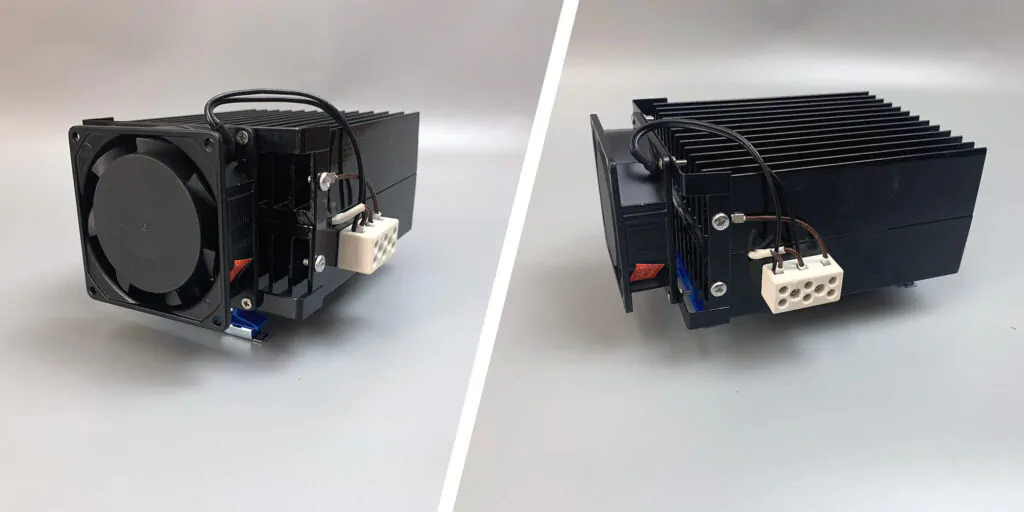
To protect equipment, heaters for control cabinets, or ОША, are used. Their task is to maintain a stable temperature inside the cabinet, reduce the risk of condensation, and create safe conditions for the operation of electronic components.
How a control cabinet heater works
ОША converts electrical energy into heat. Most often, the heating element is placed in an aluminum radiator housing, which evenly transfers heat to the air inside the cabinet. According to their operating principle, heaters are divided into two main types.
Types of heaters for control cabinets
| Heater type | Where it is used | Features |
|---|---|---|
| Convection | Small and medium-sized cabinets | Heat is distributed by the natural movement of air |
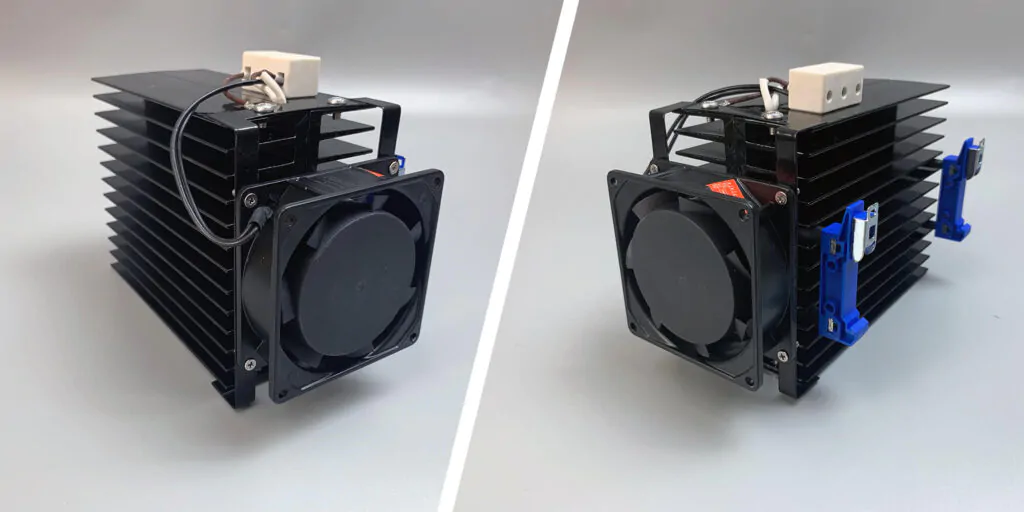
| With a fan | Large cabinets or dense component layout | Equalizes temperature faster and eliminates “cold zones” |
Temperature regulation and humidity control
For economical and safe operation, it is advisable to connect the heater through a thermostat or hygrostat. The thermostat responds to temperature, while the hygrostat responds to humidity.
In more complex conditions, combined thermo-hygrostats are used, allowing more precise control of the microclimate inside the automation cabinet.
How to calculate the power of ОША
The heater power depends on the size of the cabinet, the housing material, the installation location, the minimum outdoor temperature, and the desired temperature inside. For preliminary selection, a simplified engineering formula can be used.
Simplified calculation formula
P = k × S × ΔT
where P is the required heater power, W;
k is the heat loss coefficient of the housing, W/m²·°C;
S is the cabinet surface area, m²;
ΔT is the difference between the required internal temperature and the minimum outdoor temperature.
Calculation example
The cabinet has an approximate surface area of 2.5 m². It is necessary to maintain +10 °C inside, while the minimum outdoor temperature may be -15 °C. The temperature difference is 25 °C. For a metal cabinet, we use a conditional coefficient of 5 W/m²·°C.
P = 5 × 2.5 × 25 = 312.5 W
Therefore, it is advisable to choose a heater rated at 350–400 W or several lower-power devices placed in different zones of the cabinet.
Recommendations depending on operating conditions
| Operating condition | Recommendation |
|---|---|
| Small indoor cabinet | Convection ОША 25–100 W |
| Outdoor cabinet | Power rating with a 20–30% reserve |
| Large cabinet | ОША with a fan |
| High humidity | Thermostat + hygrostat |
| Dense component layout | Placing heaters at different heights or in different zones |
Installation and temperature regulation
Most heaters are installed on a standard DIN rail or fixed with bolts inside the cabinet. It is best to place ОША in the lower part of the housing: warm air rises and naturally heats the entire internal volume.
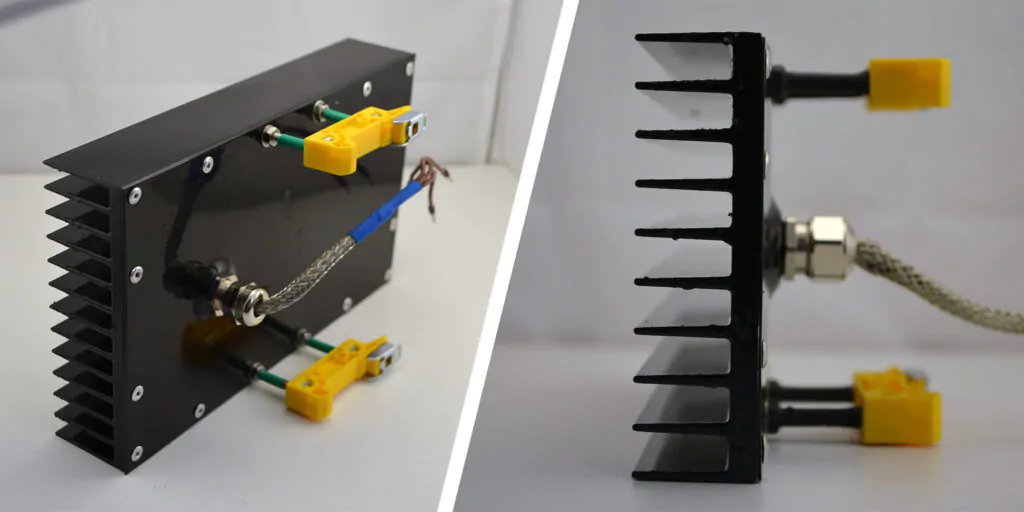
Important: the heater should not be installed close to cables, plastic elements, or sensitive electronics.
If a fan is used, the airflow should pass through the cabinet evenly, without overheating a single point. When connecting several heaters, they are usually connected in parallel, while the load current, conductor cross-section, and line protection must be taken into account.
Thermostat setting
The thermostat is set so that the heater switches on before critical cooling occurs, for example at +5 °C. This makes it possible not to wait for condensation to appear, but to prevent it in advance.
Conclusion
A control cabinet heater is not an additional comfort feature, but an element of protection for industrial electronics. A properly selected ОША reduces the risk of condensation, corrosion, controller failures, emergency shutdowns, and expensive repairs.
For the system to operate reliably, it is necessary to take into account the cabinet dimensions, operating conditions, enclosure protection rating, heat losses, installation method, and control type.
The company «Intmax» can help with the selection, calculation, and manufacture of heaters for control cabinets for specific operating conditions — from small electrical cabinets to industrial control systems.