


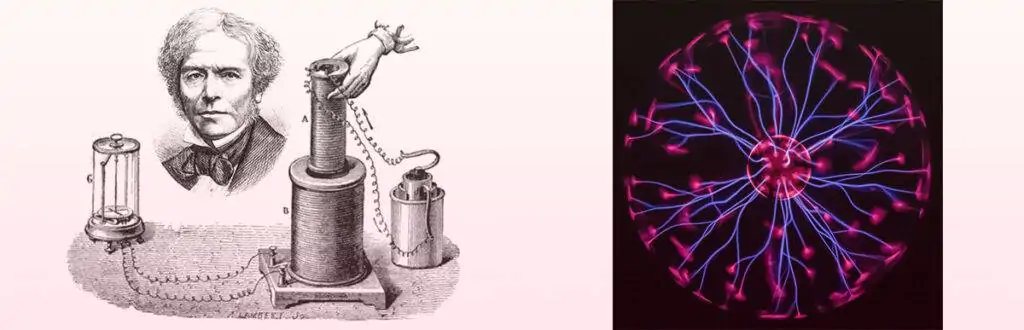
The essence of the method is the use of electromagnetic fields for fast and efficient heating of metal objects. Modern technology is increasingly used in various industries and everyday life. Let’s consider the evolution of induction heating from ancient times to the present day and try to look into the future of this technology.
The first observations of electrical and magnetic phenomena were made thousands of years ago.

What Ancient Greece is Famous For
Around 600 BC, Thales of Miletus, one of the first philosophers and scientists of Ancient Greece, noticed that amber, when rubbed with wool, acquired the ability to attract feathers and pieces of paper. Thales described this phenomenon as “attraction”, but knew nothing about static electricity.
About a century later, the Greeks discovered that magnetite was able to attract iron objects, which also sparked interest in its properties. Facts were simply recorded, without any scientific basis.
Ancient Greece was the beginning of a long journey of studying electricity and magnetism, which continued for centuries and led to revolutionary discoveries and technologies in the modern world.
What became known in the Middle Ages
Research in the field of electricity and magnetism developed slowly due to the dominance of religious and philosophical teachings. However, some important discoveries were made, which became the basis for future research.
The Chinese scientist Shen Kuo (11th century) made a significant contribution to navigation by describing the use of a compass. He noticed that magnetite could point north when it rotated freely. The discovery allowed sailors to navigate the open sea, regardless of the visibility of stars or the landscape.
William Gilbert published a treatise on magnetism in 1600, where he presented the results of his experiments with magnets and reported on their characteristics. The scientist was the first to use the term “electric”, borrowed from the Greek word ēlektron, meaning “amber”. He conducted many experiments with various materials and described the phenomena of attraction and repulsion associated with magnets and static electricity.
In general, science developed very slowly in the Middle Ages, but individual discoveries formed sources of knowledge and were carefully studied by scientists around the world.
The Age of Enlightenment: a significant breakthrough in research
The 18th and 19th centuries were a period of special development of science related to the electrical nature and magnetism. Let’s take a closer look at the key discoveries of this time.
Charles Dufay discovered in his experiments with various materials that electric charges can attract and repel, i.e. have different potentials. He used the terms “rubber” (for “+”) and “glass” (for “-“) types of current particles.
Pieter van Musschenbroek introduced the Leyden jar to the world. This device could accumulate a charge, which greatly simplified further research into electricity.
Benjamin Franklin proved that lightning is powerful, natural electricity. He used a kite to get a charge from clouds during a thunderstorm. Later, based on the knowledge gained, the lightning rod was invented.
19th century: introduction and delving into electromagnetism
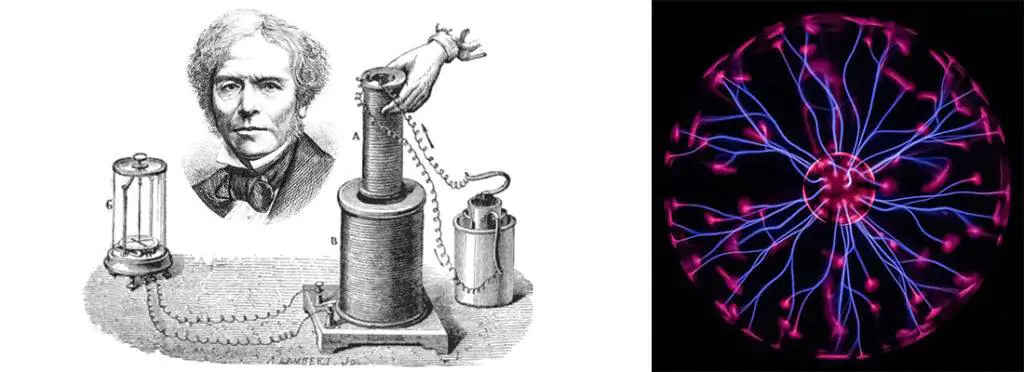
In 1820, Hans C. Oersted made an important discovery that linked electricity and magnetism. He noticed that if current is passed through a conductor, the magnetic needle of a compass will change its position.
Michael Faraday began to study this topic closely. He invented the first electric motor, which used the relationship between a magnetic field and current to create rotational motion.
Ten years later, Michael published the results of his research, stating the following: by changing the magnetic field, it is possible to reproduce current in a resistant material. The discovery later helped in the assembly of generators and transformers. Irrefutable evidence was obtained that an alternating magnetic field will heat a conductor without direct contact.
The discoveries of the 18th-19th centuries became the fundamental postulates for many technologies that are still used today.
The Birth of Induction Heating
In the 1870s, D. Maxwell developed a theory with equations that showed how closely magnetic and electrical processes are connected. Now it was possible to obtain calculation data on the processes.
Later, G. Hertz created a device for generating and detecting electromagnetic waves, proving their ability to propagate through space and interact with conductors.
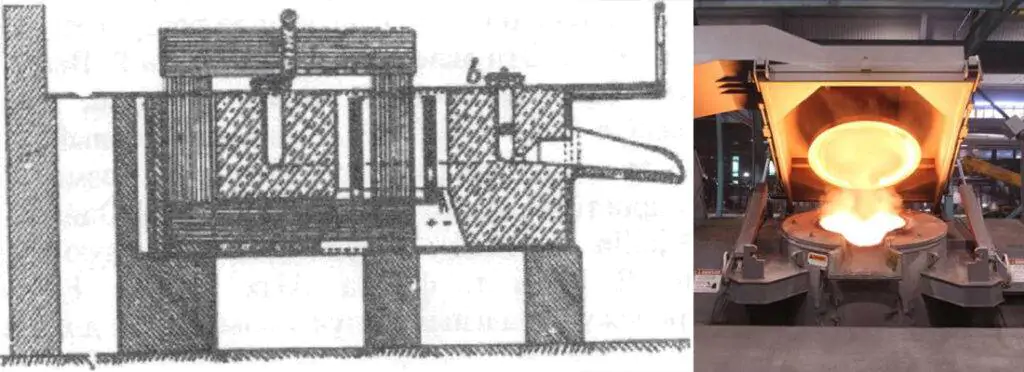
The first practical use of induction heating in the industrial sector was the induction melting furnace created by Frederick Appold. In it, an alternating magnetic field formed an electric potential passing through the metal and forming an increase in the temperature of the object.
In 1900, Edwin Northrup managed to create a more productive furnace analogue with increased efficiency of the melting processes.
The 20th century: induction in industrial terms
1910-1920s. The melting process is carried out taking into account improved production and energy indicators.
1920-1930s. Surface hardening has a positive effect on the wear resistance and hardness of the final product, while maintaining the properties of the internal structure of metals.
1940s. Induction heating has become a positive development in the production of ammunition, weapons and military equipment.
1950-1960s. It is possible to harden a number of automobile parts, which increases the service life of vehicle parts, improves driving safety and reliability of cars.
1970-1980s. Development of compact power sources for heating materials using induction. Due to their reduced size, they are perfectly integrated into production lines.
1990s. Excellent results are obtained in pasteurization of liquid products, sterilization of packaging and food, which allows to increase the shelf life of food.
Induction heating technology has adapted to new requirements and challenges of the time.
Induction heating today
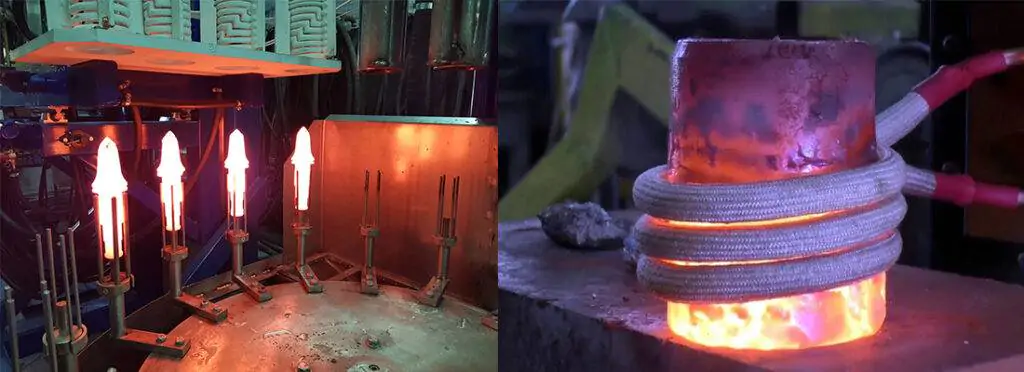
Modern induction heating technologies are widely used in various sectors of the national economy due to their efficiency and versatility. This method is based on the principle of electromagnetic induction, which allows for the rapid heating of metals and other materials without direct contact with the heat source.
Let us dwell in more detail on the use of heating using magnetic induction.
Metallurgy
- Induction furnaces are used for melting various metals, including steel and non-ferrous metals. Heating does not take much time, energy losses are optimized.
- Casting makes it possible to manufacture complex configurations with high precision.
- Heat treatment, namely hardening and annealing, improve the hardness and strength of metals.
Mechanical engineering
- The process of hardening machine parts ensures that the required level of hardness is achieved.
- Tempering practically eliminates (greatly reduces) internal stresses in materials, improving their performance characteristics.
- The technology is suitable for soldering various metal parts, providing a strong connection.
Automotive industry
- Induction heating of body components increases their strength and durability.
- Gear hardening ensures the desired wear resistance and reliability of transmission units.
Aerospace industry
In aircraft engineering, induction heating is needed to join lightweight and durable materials such as titanium and aluminum. This allows for the creation of reliable structures with high strength.
Semiconductor industry
Induction heating is used to grow crystals for semiconductors, which allows for the control of the quality and properties of the resulting materials.
Food industry
- Sterilization of packaging and food products ensures their safety and long shelf life.
- Fast and uniform heating of food allows for the preservation of its nutrients and taste.
Medicine
- In medical institutions, induction heating is used for the rapid sterilization of surgical instruments.
- The technology is in demand in the treatment of cancer, when affected cells are heated to a temperature that promotes their destruction.
Advantages of modern induction heating
Let’s summarize the information about the advantages of the method.
- Induction heating requires significantly less energy compared to traditional methods, such as gas or electric heating.
- The ability to continuously control the temperature prevents overheating and damage to materials, which is especially important in high-precision industries.
- The heating process is fast and uniform, which reduces the processing period and increases productivity.
- The absence of harmful emissions during thermal operations makes induction equipment more environmentally friendly compared to other methods.
- Such systems are easily integrated into automated production lines, which allows you to optimize processes and reduce labor costs.
The technology continues to develop, offering new opportunities to increase production efficiency and improve product quality.
What is known from the latest achievements and implemented innovations
The current state of induction heating demonstrates its importance and variety of applications in various industries.
- High-frequency converters based on gallium nitride and silicon carbide have shown higher efficiency compared to silicon analogues. The positive effect of these materials on the output power of induction equipment has been noted.
- Inductors obtained by 3D printing have a complex geometric shape. They are manufactured faster, cost less, and are better suited to specific operating conditions.
- Thanks to nanotechnology, materials are created that do not rust, have significant conductivity, heat resistance, and transfer heat efficiently.
Embedding induction heating into general plant process control systems ensures:
- regular monitoring;
- detection of minor faults to prevent major technical failures;
- data analysis using artificial intelligence;
- creation of remote access to monitor the technical condition of units (lines) and the efficiency of technological processes.
Forecasts in the development of induction heating are promising. The research conducted is supplemented by new, proven results. This opens up further prospects in the field of technology, ecology, and industry in different countries.