


Infrared light lies between the visible spectrum and microwaves. It is one of the methods of heat transfer. Convective transfer determines the equalization of the temperature of objects during the transfer of energy in a liquid, gaseous medium. IF is electromagnetic radiation, in which it is not the atmosphere in the room that heats up, but objects. Another option is contact heating when touching objects. Let’s consider it in more detail.
What is heat conduction
Due to thermodynamic equilibrium, hotter objects give off excess energy to colder ones. If we consider the process from physical points of view, then the atoms and molecules of one body actively collide with similar particles of another body until their thermal index equalizes.
Heating occurs after the body passes the received energy potential through itself. If its thermal conductivity value is high, then heat is quickly absorbed and moved further. And the object itself only slightly increases its temperature. Let’s explain this with an example.

When you touch the glass in the window on a sunny day in winter, it remains cold, and your hand immediately feels pleasant heating. Glass has a fairly high thermal conductivity parameter, it is equal to 1 W/mK. In air, it reaches 0.026 W/mK. Therefore, foam with pores filled with air is considered a good insulation (holds energy, and does not conduct through itself). Diamond is a remarkable, most powerful source of thermal conductivity as its heat transfer value is over 2500 W/K.
There is no thermal conductivity in a vacuum environment, because there are no particles capable of transporting the prevailing thermal potential. Only radiant energy functions here.
The ability to transfer heat is most actively manifested in infrared study. Imagine an ordinary radiator mounted on a wall. OH raises the degree in the room in two ways: convection (about 70%) and radiation (about 30%). If we take an analogue of a radiator and hang it in the ceiling zone, then convective heat transfer is no longer rational, but only IR heating works.
Theory of infrared radiation

This type of energy transfer implies a light component, therefore, it obeys the laws of optics. The infrared component is received by both solid and liquid bodies, whose temperature exceeds that of the environment. There are short-wave (0.74-2.5 microns), medium-wave (2.5-50 microns) and long-wave (50-2000 microns) light. With an increase in t⁰, the study power increases, and the wavelength decreases.
Infrared radiation was discovered in 1800 by William Herschel. He chose the Sun for the object of study and was in search of a way that would reduce the heating of the tool used in the work. An English scientist discovered that most of the heat is in the invisible zone, which is located behind the red light. The IR spectrum is involved in the molecular motion of particles, during electronic transitions, which opened up an additional niche for studying processes occurring in crystal lattices.
Infrared radiation is part of the field of electromagnetic waves. In 1923, the physicist A.A. Glagolyeva-Arkadyeva proved that natural lighting, radio waves and infrared rays have the same “roots” of occurrence. Without the wave factor, we would not be able to see the surrounding objects, we would be deprived of mobile communications, the ability to listen to receivers, watch TV, and use technology.
How can you explain the essence of infrared radiation in simple words? Invisible rays penetrate the body, causing a pleasant body and activating the process. The visible part remains on the surface of objects and turns into an illuminating spectrum.
How useful are infrared rays for humans and animals
With the help of the transmitted energy of the Sun, vitamin D accumulates in the body. There is no doubt that infrared rays do this. Imagine if, at a distance of 150 million km from the Earth, a celestial body would heat everything in a row: clouds, comets, meteorites, nebulae and other objects above our head. Then people would get a small particle of natural heat, and the harvest of cereals, fruits, berries, vegetables would never be expected.
Infrared rays are safe for living beings. Longwave have a healing effect. Those who have ever been in the village at the time when they were burning wood, probably remember how well the body “responded” to an artificial source of infrared radiation. That is why old people climb onto the stove and warm their bones on the couch, groaning with pleasure. Yes, and by the cat, curled up there in a ball, you can understand that the stove is obviously good.
Our bodies easily pass useful rays inside. This contributes to proper cellular development, improvement of the body’s immune defense, part of the physiological processes normalizes, and blood counts improve.
What is the benefit of buying IR heaters
Devices that use long-wave IR technology are convenient in that they are used in rooms with and without thermal insulation, with hermetically sealed windows and in the presence of cold air being blown in. They are also included in the street space, creating cozy locations on the sites of cafes, restaurants, large verandas. They are in demand in factory and warehouse areas, in office and retail space. The list of applications for devices is almost unlimited. They work on an electric carrier and on gas, there are adjustable and fixed above the head.
For a conscientious manufacturer, the quality of the goods produced is a priority. It is focused on European requirements, so it eliminates unpleasant moments. Such as swelling of products when heated, violation of the contact group of connection, mechanical damage due to drying and cracking. A margin of safety is necessarily given so that the products do not function at critical values of power and temperature stability. This provides a certification that ensures the fulfillment of guarantees for the buyer.
The company “Intmax” manufactures products with a limitation in terms of power density higher than that established by the standards
Ceramic materials
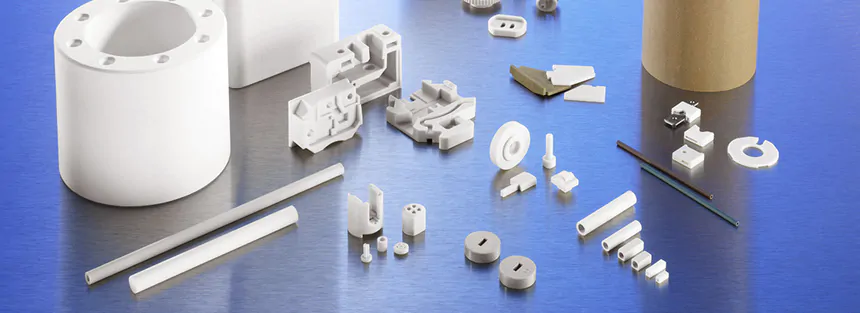
The raw materials for the production of heaters with a long service life are ceramic materials. They are not afraid of difficult climatic indicators and fully retain their original potential during long-term operation. After several years of use, they save the initial configuration, do not change the initial dielectric parameters.
Cordierite
It has significant chemical inertness (including acid resistance). Created from clay, feldspar, resistant to temperatures of -50 … + 1300⁰С, therefore it is often used to form an insulating layer around fechral, nichrome conductive elements. Does not dry out, preserves integrity during long-term voltage supply. Ideal for infrared heating equipment.
Periclase
Magnesium oxide with the addition of iron, aluminum and silicate oxides is one of the best options for high temperature processes and heat transfer. It has excellent flowability and is easily compacted in heating elements. Its task is to perform high-quality insulation in the heater. The only “minus” is the absorption of free moisture, so it is recommended to warm up the heaters at the beginning of operation at low voltage values.
Technical porcelain
Made on the basis of kaolin clays, has a high percentage of crystalline glass phase. It is represented by two types of materials: quartz and pressed. Works well in humid air, is inert to fire, has a high barrier to breakdown by currents. It is used for the manufacture of terminals for the activation of wires. For products with the correct configuration, quartz porcelain is used, and for complex shapes, tightly pressed porcelain is used.
The use of infrared heating in residential premises
To achieve a comfortable temperature, infrared heaters are used as the only or additional way to increase the temperature. Therefore, it is necessary to figure out in advance what are the “strong” and “weak” sides in such a source of heat transfer.
Advantages
- No combustion of oxygen.
- The term of application is more than 10 years.
- Functioning without noise irritants.
- Organization of local and general heating.
- Positive effect on the protective functions of the body.
- Application in closed walls and outdoors.
- Health safety.
- Vertical heat distribution.
Flaws
- Inability to change the position of the heat source.
- Compliance with the conditions for the minimum allowable height.
- The need to periodically turn off the devices.
And if you compare with other types of devices? Spiral type units use a lot of current, get very hot and can lead to accidental fires. Oil fireplaces are more economical, but the heat is distributed over a small area, it takes a long time to raise the temperature. Convectors are safe, but very slow in operation.
In IR devices, high efficiency, it is possible to form a directed heat flow, the room is heated from top to bottom. Long-wave models are chosen for indoors, short-wave models for outdoor placement. Instances with a thermostat are convenient for adjusting the level of heat supply. In modern models, automation of the device operation is proposed. Operates quietly, does not cause voltage drops in the network.
How a ceramic emitter looks and functions
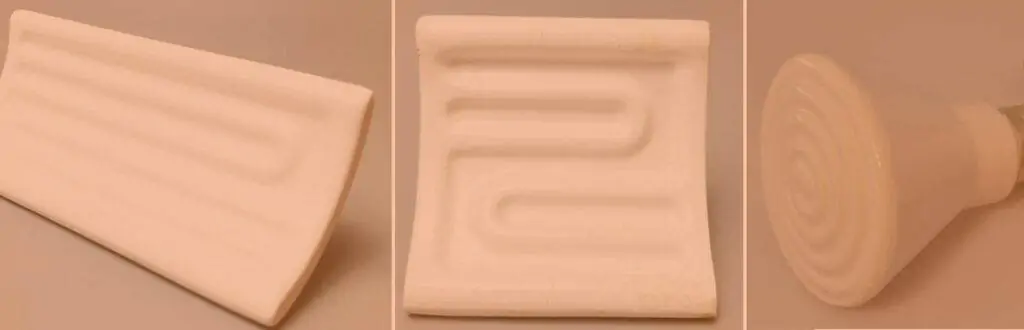
This is a heating element placed in a heat-resistant shell. The heating energy is transferred to the ceramic body, and from it to the walls and objects in the room.

The panel form has a significant area of heat distribution, so it quickly “shares” the received temperature. The form is flat and embossed. The front part of the structure shows what form the heating element is placed inside. The back has cables with protective beads. The power of devices is determined by the heat supply density and occurs from tens of watts to several kilowatts.
On request, designs with an open working panel are produced. They should be placed on the ceiling so as not to burn inaccurate users, because the heating temperature reaches +900⁰С. The absence of a cover on the frontal zone is made for the purpose of prompt heating of the workshop premises.
The product line is divided into 2 groups:
hollow emitters. They have a reduced weight, so they heat up faster. They perform well when there is a need for devices that need to be activated and deactivated from time to time in order to stabilize the value of the thermal index. The barrier is also hollow, so heat transfer through the back.
solid. They accumulate heat longer, work longer, cool down more slowly. The distribution of heat occurs through the entire surface of the product, using reflectors. The reflector returns the heat studied to the unwanted area.
On the ceiling or wall
A person produces around a wave length of 6-20 microns. If a similar heat flow envelops a living being, then the waves will begin to penetrate the body. No wonder they call it blessed warmth. There is a feeling of relaxation, relief.
Infrared heaters are made in two types: ceiling and wall.
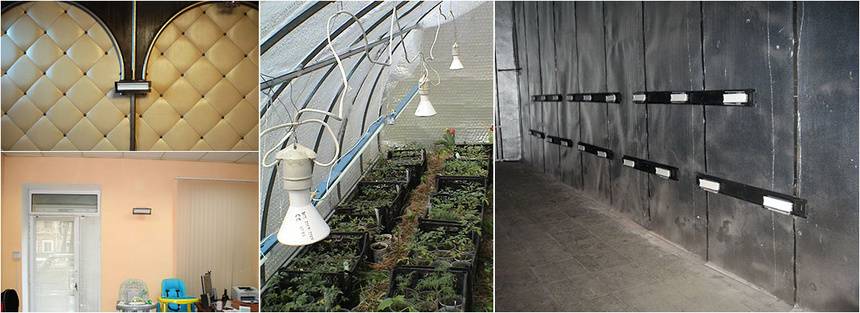
- Fixing equipment overhead is convenient if there is no free space on the walls. Devices can be built into a decorative panel row or placed under the ceiling. Installation above internal doors and window packages will help prevent frosty and damp air from penetrating from the street.
- Wall type mounting. If you do not want to block the ceiling or there is no way to attach the device there (for example, a multi-level plasterboard structure above your head), and there is free space on the vertical wall panels, use this opportunity to heat the room.
It is important to determine the heating element.
Wall-mounted IR heaters are available in several modifications:
halogen. They are best used in open space or areas with irregular presence of people, since waves in a limited space can do harm. Used for a small heating area, spend a significant amount of energy, last up to 6000 hours. They are easy to break, so you need to be very careful when installing;
quartz. It is better to choose non-luminous heaters, in which there is no infrared and ultraviolet radiation (the second type can cause eye damage and skin pigmentation). Special quartz glass separates the beams, passing the range of 0.7-3 microns, and stopping 0.8-25 microns. In monolithic structures, there is a tube with a nichrome spiral, where quartz sand is hermetically placed. All components are inside the modified stone panel;
carbon. Mobility is convenient, as the device can be deployed for spot heating of a separate zone. The heating element receives a vertical or horizontal position (depending on the modification). Designed for the long-wave spectrum and an operating time of 10,000 hours;
ceramic. Thin panels with an excellent interior component. Safe wavelength, economical energy consumption and a 25-year period of use put these devices in the lead in the list of heaters.
For rooms up to 20-30m², low-temperature models are suitable. On the overall areas, high-temperature analogues are installed, which are called dark (they do not shine during operation).
Ceiling and wall mounting
If you are not a curiosity to hold a power tool, then when placing the device over your head or wall plane, you will not need the help of a specialist.
Mounting in the ceiling area will require the purchase of metal chains, brackets or clamps. Before buying, you need to check whether they can support the weight of the panel without changing their original state. That is, deformation, bending of mounting fasteners are unacceptable. First, these elements are placed in the ceiling panel, and then the heating device is fixed on them. It is necessary that the vertical height to the ceiling is more than 3m.
Wall mounting takes into account special safety, because the outer part of the device heats up to +90⁰С and more. If there are small children in the house, place the device at a height of 1.5-1.8 m. Animals can also be curious. To prevent damage to the dog, place the heater in the middle of the wall or higher. Make a couple of holes, put the bracket and hang the IR device. Do not forget that it is better not to mount the device near furniture.
Accessories that improve comfort of use
The manufacturer cares about the convenience for users, therefore, offers additional options.
- Heating degree regulator. In terms of functionality, it resembles a sensor that is installed in a boiler: it turns on and off to maintain the set thermal level. It comes in mechanical and electronic versions. For its proper installation on the wall will require experience.
- Overheat protection. A cut-off switch is used that turns off the device during prolonged use in the absence of the owners.
- A remote control that helps turn on the heater from a distance.
All the accessories provided for installation are included in the box with each model, so it can be done immediately after purchasing the device. If you choose self-installation, do not forget to check the instructions.
An example of calculating the radiation power and installation of infrared heaters
The priority calculation indicator when choosing and counting the number of devices is specific power, that is, the amount of radiation that falls on a unit area.
| № | Object type | Specific power, W / m2, to achieve the desired thermal index | ||
| +13⁰С | +16⁰С | +19⁰С | ||
| 1 | Well insulated | 60 | 80 | 100 |
| 2 | Weak isolation | 90 | 120 | 150 |
| 3 | There is no insulation | 200 | 230 | 260 |
| 4 | Semi-open space | 230 | 280 | 330 |
The heat flow can be central and point. Infrared rays seem a little warmer than they really are. The difference between tactile and actual indicators does not exceed 4⁰С.
The Intmax company advises to adhere to the optimal values during installation. This is important to achieve a uniform distribution of rays and maximum exposure to the heated area.
| Options | Wall placement | Wall placement | ||||
| Mounting height, m | 2,5 | 3 | 3,5 | 2,5 | 3 | 3,5 |
| Heating area, m² | 8 | 20 | 40 | 17 | 24 | 32 |
Let’s take arbitrary values to show the calculation of the required number of radiators, as well as their installation location.
Given: room area 50 m² (rectangle 10 x 5). Insulation is insignificant, the desired temperature after heating is + 16⁰С.
Specific power – 120 W / m². Mounting height will be 3m, placement takes place on the wall.
Total power of devices: 50 * 120 = 6,000 W (6 kW). If you choose a specific brand of 1000 W radiators, then you will need 6 pieces. Placement will be performed along the perimeter in pairs opposite each other.
Call “Group Intmax” to get infrared heaters soon.