


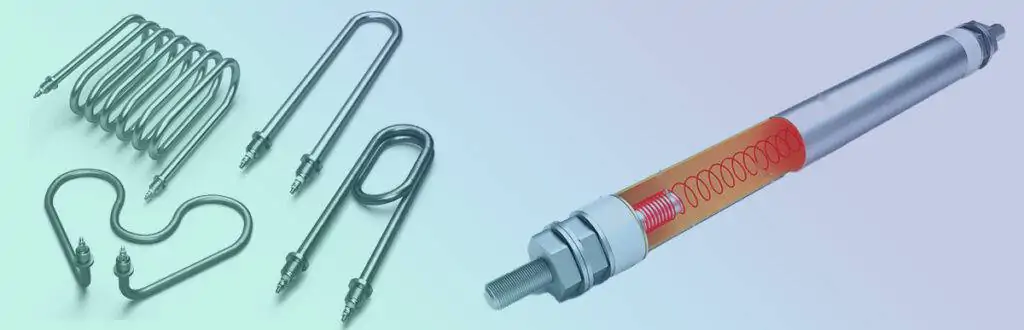
Heaters are the working element of a significant number of household appliances used by every family. They were developed more than a century ago.
- The initial experiments on creation were carried out at the end of the 19th century by James Joule. It was he who in 1841 discovered the Joule-Lenz law, according to which the heat emanating from a functioning conductor with current depends directly on R, I2 and t flowтока . For experiments, the physicist used a wire made of platinum through which he passed electricity. He measured with a calorimeter the value of the heat released at different rates of current. The law he discovered made it possible to create electrical appliances that we still enjoy using today.
- The first prototype of a modern heater was invented in 1903 by the American engineer William Hadaway. It was a Ø12 mm metal tube with a Ø6 mm nichrome coil inserted into the inside of the tube. This allowed uniform heating of water or air passed through the tube. Hadaway patented a tubular electric heater with an inner conductor. This invention marked the beginning of industrial production of heating elements.
- In 1905, American inventor William Mosley improved the design of the heating element by placing the heating element in a protective shell and achieving a more even heat distribution. This made it possible to use heating elements in household appliances for heating water, air and cooking.
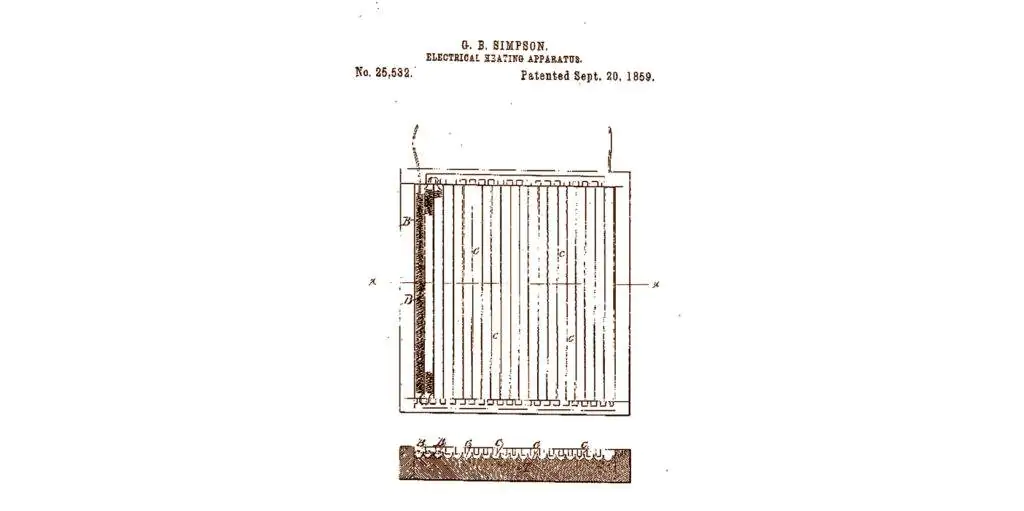
- English physicist George Simpson made a great contribution to the theoretical substantiation of the principles of operation of heating elements in the 1910s. He investigated the dependence of heat release on various design parameters of the heating element, such as diameter and material of the heating element. The results of his work allowed to optimize the model for qualitative heating.
- The year 1918 was marked by an event that caused a great international resonance. F. Berry, who worked at General Electric, issued a patent for his brainchild. The design included a metal chopper with a spiral of resistant material. The powder was insulated, which also held the spiral in position. It included a metal tube with an inner heating spiral and used a special powder as an insulating and fixing element. This made the design flexible and the heat was distributed evenly. The dielectric significantly reduced the occurrence of short circuits in the circuit.
- In the 1920s and 1930s, research was actively conducted on the use of heating elements for industrial purposes. In 1928, American engineer Earl Winslow developed a technology for manufacturing flexible heating elements, which made it possible to use them for heating various surfaces and objects.
- English physicist Francis Berry in 1930 proposed the use of heaters to electrically heat buildings to replace traditional water systems.
Heating elements became widespread in the 1950s and 1960s due to the development of household appliances and electrification of households. Engineers from Philips, Moulinex, Tefal and other companies developed new models of kettles, irons, heaters and other appliances with heating elements for home use.
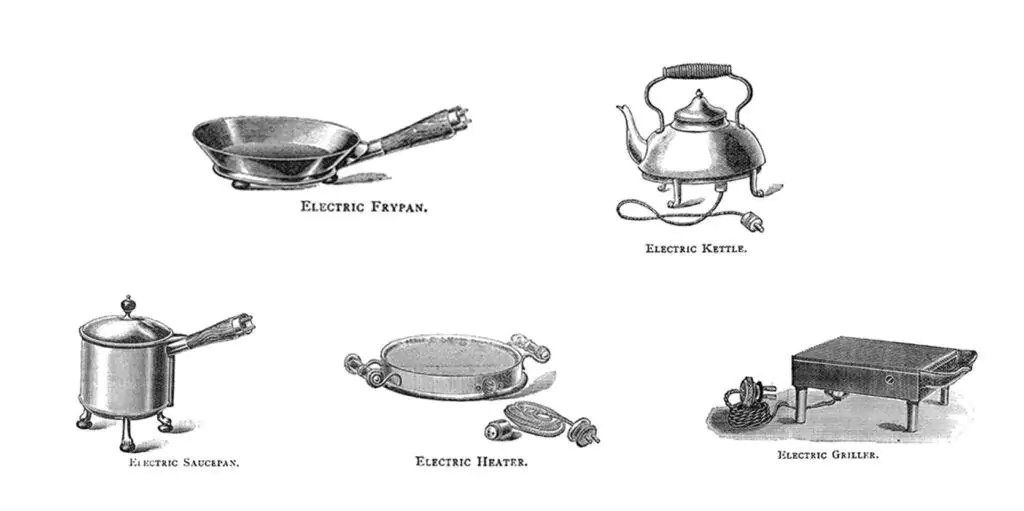
Manufacturing electric heaters today
Modern heating elements are made of nichrome, iron-chromium-aluminum and other alloys with high resistivity. Due to optimization of design and parameters, modern heating elements have high heating performance with relatively small dimensions. They are actively used in all types of household appliances, industrial furnaces, heating and hot water supply systems, allowing high-quality transformation of current energy into heat potential.
Heating elements are widely demanded in food equipment. For example, in coffee makers they heat water to the desired brewing temperature. In ovens, they create high temperatures for baking and frying.
Below is a comparison table of the different types of heating elements
| Type of heater | Material | Form | Power | Application |
| tubular | Nichrome | Cylindrical spiral | 500-5000 W | Water heaters |
| Tape | Nichrome | Flat tape | 50-500 W | Surface heating |
| Ceramic | Ceramic with heating element inside | Cylindrical or flat | 50-2000 W | Ovens, heaters |
| Flexible | Silicone with carbon heating element | Any | 50-200 W | Local heating of equipment |
In the future, it is possible to create heaters based on nanostructured materials, which will increase the efficiency of energy conversion. Research is also underway to integrate electric heaters into “smart” control systems to optimize energy consumption. Widespread introduction of renewable energy sources will lead to the emergence of hybrid heating systems with heating elements.
Why tubular electric heaters are so popular in the manufacture of plastic products
They are widely used in many stages of the production process of a range of plastics products due to their ability to control the heating temperature with high precision.
- At the raw material preparation stage, these devices are needed to heat and melt polymer pellets in extruders before feeding the melt into the molds. Precise control of the melting temperature allows to obtain a homogeneous mass without localized overheating.
- Special heating elements for molds are used during molding of products. They ensure uniform heating to the set values, which excludes defects of molded products.
- the role of temperature rise and maintenance devices is particularly important in the molding of plastic sheets. The sheet is heated by heaters to a plastic state, then placed in a mold to give the desired geometry.
At the processing stage of finished plastic parts, heating elements are used for controlled drying, dimensional stabilization, and internal stress relief. Precise mode in the furnace ensures high product quality.
Of particular note is the use of heating elements in FDM 3D printers. The heater converts the material into a thin filament fed into the print head. This allows the melting temperature to be precisely controlled over a wide range.
Due to their compactness, high power, efficiency and precise temperature control, heating elements are indispensable elements in the production of plastics and plastic products. Their installation at different stages of the process improves the quality and expands the range of products.
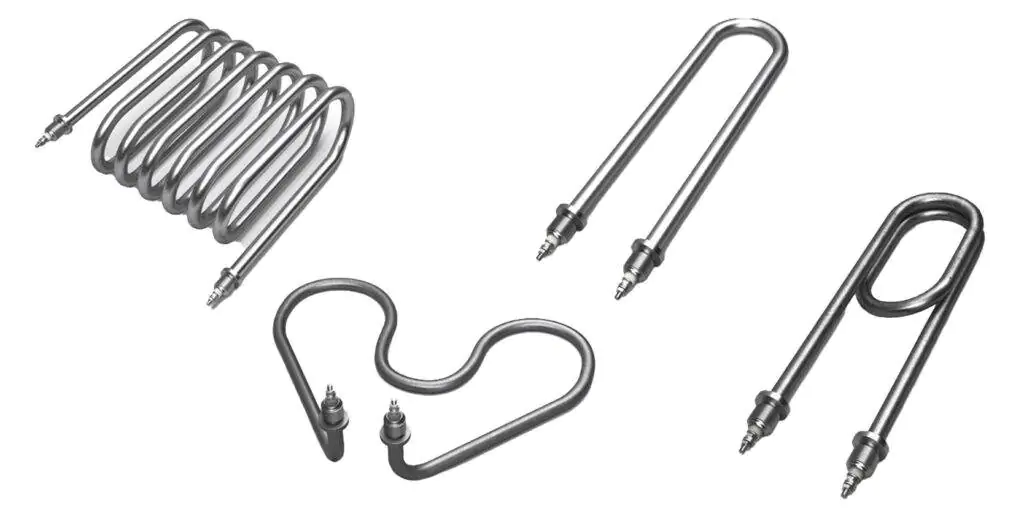
What modern tube-type heating elements consist of
These are developments that combine various elements to convert electricity into heat efficiently and safely.
- They are based on a metal casing that provides mechanical protection and heat dissipation. It is made of heat-resistant, rust-neutral materials (stainless steel).
- The key working element is a heating coil made of high resistivity alloys. This results in intense heating when current is flowing.
- Contact elements located in the insulated areas of the housing are used to connect the coil to the energy source. They form a reliable contact with the electric potential.
- Insulation plays a crucial role in minimizing current leakage and the occurrence of short circuits. Inorganic compounds with high dielectric properties are used for this purpose.
The design uses fillers to improve heat transfer and heater fixation. And also sealing elements for protection against external influences.
Each component of a tubular heating element is important in ensuring its reliable operation over its specified operating period.
Where electric tube heaters are used
The devices are actively used in various fields:
- household appliances (kettles, coffee makers, water heaters, etc.);
- industry (ovens, dryers, extruders, etc.);
- heating (boilers, other space heating devices, etc.);
- agriculture (heating of greenhouses, greenhouses, incubators, animal feeding and housing equipment);
- food industry (various heat engineering equipment for frying, baking, dehydration);
- medicine (sterilizers, drying cabinets, heaters for medical institutions);
- transport (air dryers of truck braking systems, heating of windshield washers, electric heating of public transport, heating of turbine cap studs).
For those who are interested in the topic of purchasing heaters, we recommend contacting Intmax. You get products created for specific production characteristics. And this means that the production output will be made according to the technological production charts and the final requirements for the release of the range.