


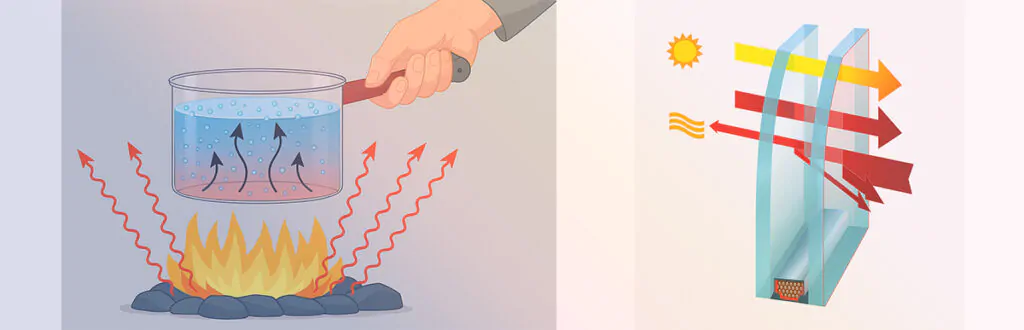
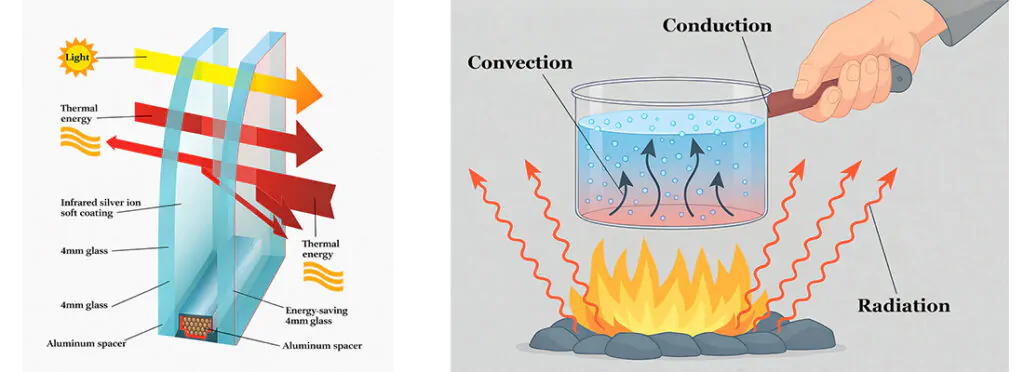
Thermal conductivity is one of the key characteristics of materials that directly affects heating efficiency, speed, and uniformity. It determines how quickly a heater transfers heat to the working medium, how stable the temperature will be, and what level of heat losses will occur during operation.
When designing and selecting industrial heaters, it is important to consider not only electrical parameters, but also thermophysical properties of materials — thermal conductivity, thermal diffusivity, and the influence of structure and temperature. Errors at this stage can lead to local overheating, reduced service life of heating elements, and excessive energy consumption.
This article examines the fundamental laws of thermal conductivity, the mechanisms of heat transfer in solids, and presents formulas and tables used in engineering calculations. Special attention is given to the practical selection of materials for heaters, taking into account real operating conditions.
1. Fourier’s Law of Thermal Conductivity: Formulas and Practical Calculations
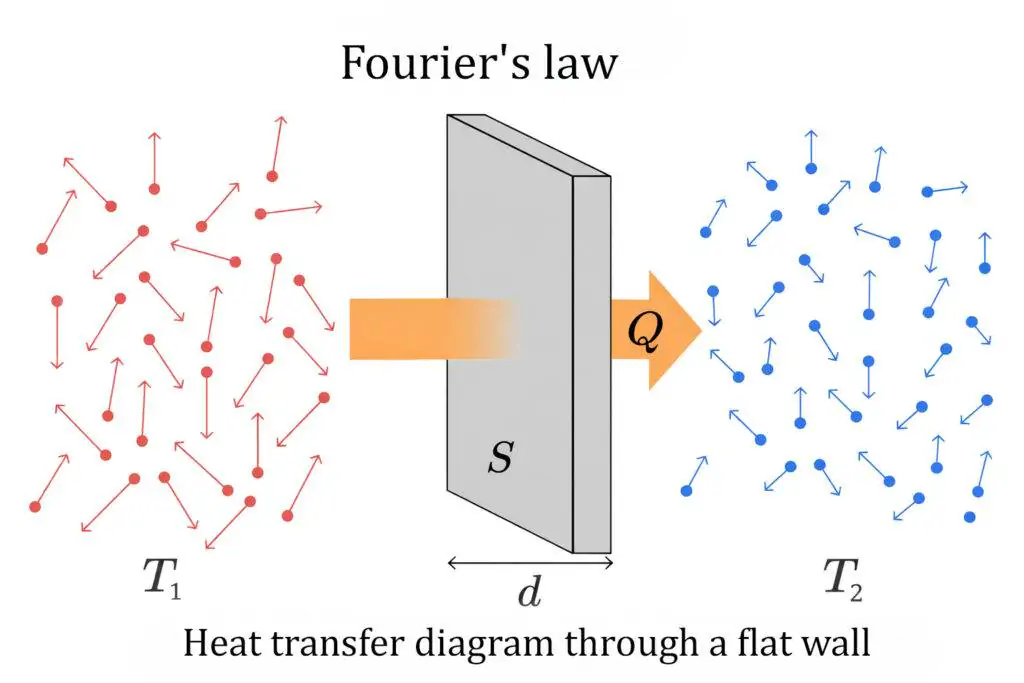
Thermal conductivity characterizes the ability of a solid body to transfer thermal energy from one part of it to another when a temperature difference exists. In general, heat is always transferred from a hotter region to a colder one.
In a one-dimensional steady-state regime, the process of thermal conduction is described by the differential form of Fourier’s law:
where the amount of heat dQ transferred during time dt through an elementary area ds is proportional to the temperature gradient along the normal to this area. The minus sign indicates that the heat flux is directed toward decreasing temperature.
In vector form, Fourier’s law is written as:
where q is the heat flux density vector and ∇T is the temperature gradient. This form is used to analyze heat transfer in the general case, particularly for complex geometries and non-uniform materials.
Why Does Fourier’s Law Contain a Minus Sign?
The temperature gradient is a vector that mathematically points in the direction of increasing temperature (from cold to hot). However, according to the second law of thermodynamics, thermal energy is always transferred from a hot region to a cold one.
The minus sign in the formula aligns the mathematical direction of the temperature gradient with the actual physical direction of heat transfer.
Engineering Form of Fourier’s Law for a Plane Wall
For practical calculations in steady-state thermal conditions, when heat flows through a plane wall of constant thickness (for example, a furnace wall, the casing of a heating element, or a thermal insulation layer), Fourier’s law is used in its integral form:
This formula allows quick estimation of heat losses or heat flow through a material, knowing its thickness, surface area, and temperatures on both sides. This expression is most commonly used in engineering heat transfer calculations.
Thermal Conductivity Formula for a Cylindrical Wall
In industrial heating applications, cylindrical surfaces are very common: pipelines, cartridge heaters, band heaters, and extruders. In this case, the heat transfer area changes with radius, and using the plane wall formula leads to inaccuracies.
For a cylindrical wall, the heat flow is determined by the following formula:
This equation is critically important for calculating pipe insulation, selecting the power of cartridge and band heaters, and evaluating heat losses in tubular systems.
Main quantities used in the formulas:
- Q (W) — total heat power transferred through the surface
- q (W/m²) — heat flux density
- λ (W/(m·K)) — thermal conductivity coefficient of the material
- δ (m) — wall thickness
- S (m²) — heat transfer surface area
- ∇T (K/m) — temperature gradient
- d1, d2 (m) — inner and outer diameters (for a cylinder)
2. Thermal Conductivity of Anisotropic Bodies in Industrial Materials
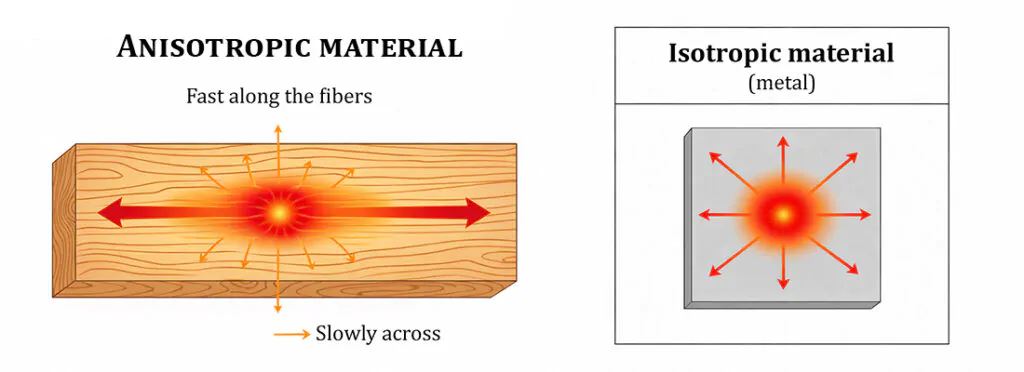
In most simple cases, materials are assumed to conduct heat equally in all directions. Such materials are called isotropic. However, under real industrial conditions, engineers often deal with anisotropic materials, in which thermal conductivity depends on direction.
For anisotropic solids, the heat flux density in the general case does not coincide with the normal direction to an isothermal surface, and heat can propagate along different paths with varying intensity.
Anisotropy — Explained in Simple Terms
To understand the essence of anisotropy, it is not necessary to immediately refer to tensors. It is enough to imagine a wooden board.
Heat, like an axe, passes much more easily along the wood fibers than across them. This is a clear example of anisotropy — when the properties of a material depend on direction.
In metals, the structure is usually closer to isotropic, but in many modern materials used in industrial heating, the structural orientation plays a decisive role.
Mathematical Description of Thermal Conductivity in Anisotropic Bodies
In the general form, Fourier’s law for an anisotropic material is written as:
where the coefficients λij form a symmetric second-rank thermal conductivity tensor, which describes how heat propagates in different directions within the material.
In practice, anisotropic materials are usually described in a system of principal thermal conductivity axes (x, y, z). In this case, the equations are significantly simplified:
qy = – λy · (∂T / ∂y)
qz = – λz · (∂T / ∂z)
Anisotropic Materials in Industrial Heating
For engineers involved in selecting or operating heaters, anisotropy has practical significance. Typical examples include:
- Graphite and carbon-based materials
Thermal conductivity along the layers is several times higher than across them. This is important when using graphite heating elements and gaskets. - Layered electrical insulation materials (micanite, textolite)
Micanite (based on mica) conducts heat well toward the heated part, but much worse along the layer. This directly affects heat dissipation and heating uniformity. - 3D-printed parts
Thermal conductivity depends on the layer deposition direction. A part may dissipate heat efficiently in one direction and create local overheating in another.
These effects are especially important when working with cartridge heaters, band heaters, and tubular heaters.
Why Anisotropy Must Be Considered During Design
Ignoring anisotropy can lead to serious engineering problems. If the directional dependence of thermal conductivity is not taken into account, a heater may create local overheating (hot spots).
In such zones, heat does not have enough time to spread evenly and accumulates in specific areas, which leads to:
- non-uniform heating;
- reduced service life of the heating element;
- accelerated aging of insulation;
- premature equipment failure.
That is why, when selecting materials and designing industrial heaters, thermal conductivity anisotropy must be taken into account already at the design stage.
3. Thermal Diffusivity: How Fast a Material Heats Up
When selecting an industrial heater, it is important not only how much heat a material can transfer, but also how quickly it reaches the operating temperature range. This property is described by thermal diffusivity.
Thermal diffusivity (denoted as a) is a characteristic of a material’s thermal inertia — the rate at which temperature inside a solid body equalizes during heating or cooling.
“How quickly will the heater reach operating conditions?”
Physical Meaning of Thermal Diffusivity
- High thermal diffusivity (a): The material responds quickly to heating, warms up rapidly, and cools down just as fast.
Typical examples: copper, aluminum, silver. - Low thermal diffusivity (a): The material heats up more slowly, but stores heat well and retains it for a long time.
Typical examples: ceramics, fireclay, high-temperature insulators.
Heat Conduction Equation (Transient Process)
Under real conditions, heating is a transient (non-stationary) process. The change in temperature over time is described by the differential equation:
c · ρ · (∂T / ∂t) = ∇ · (λ · ∇T) + qv
Classical Form of the Equation
If the thermophysical properties of the material do not depend on temperature, the equation simplifies to:
∂T / ∂t = a · ∇2T + qv / (c · ρ)
where a is the thermal diffusivity coefficient.
Formula for the Thermal Diffusivity Coefficient
For practical calculations, the key is determining the coefficient a:
a = λ / (cp · ρ)
This formula shows that the heating rate is determined by the balance between the ability to conduct heat (λ) and the ability to store it (cp · ρ).
Definition of Variables:
- a (m²/s) — thermal diffusivity coefficient
- λ (W/(m·K)) — thermal conductivity of the material
- cp (J/(kg·K)) — specific heat capacity
- ρ (kg/m³) — material density
- qv (W/m³) — volumetric heat generation rate
- ∇2T — temperature Laplacian (spatial equalization)
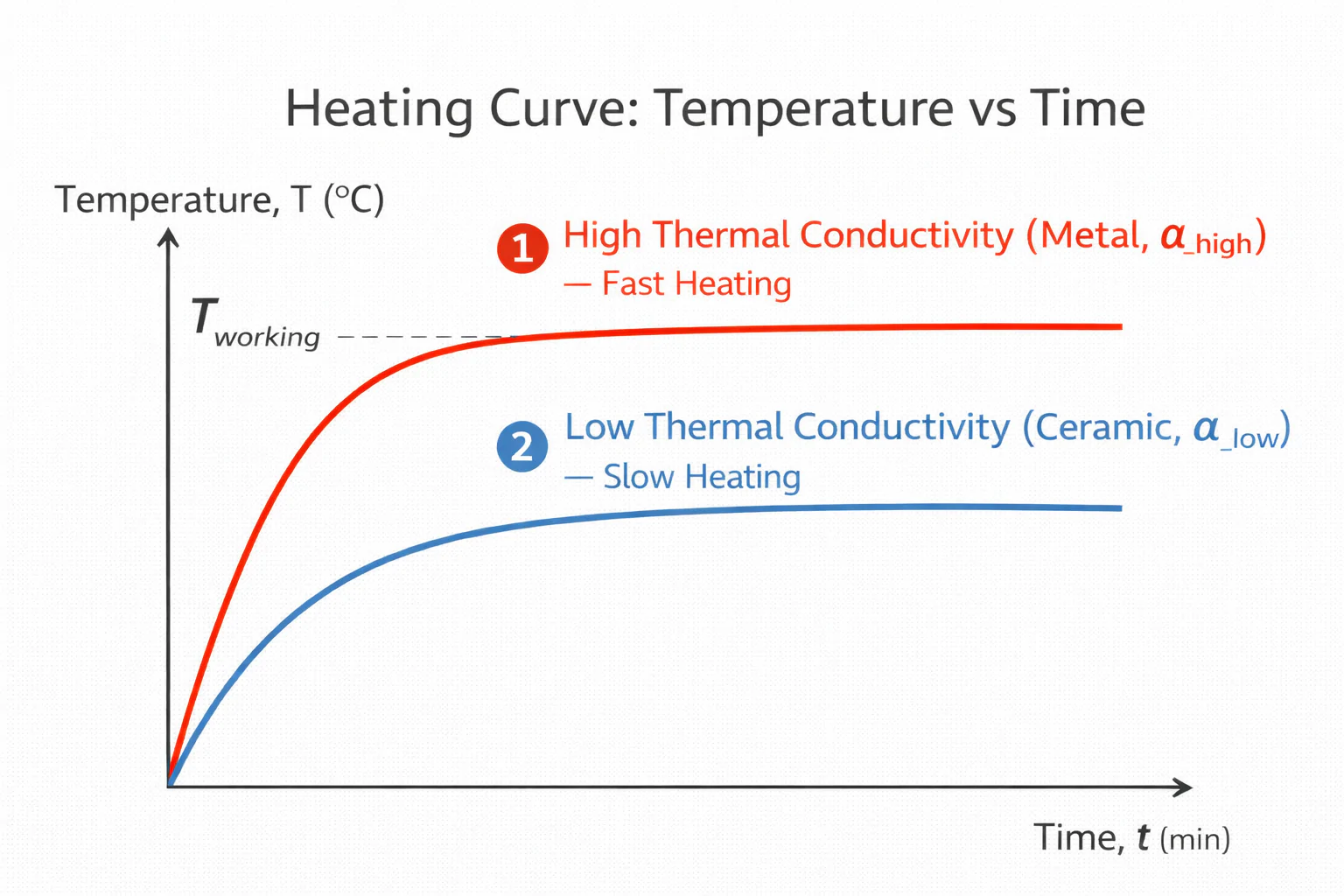
Practical Example: Metal vs. Ceramic
Thermal diffusivity directly helps to select the correct type of heater:
Metal Heaters (Cartridge Heaters, Tubular Heaters)
High thermal diffusivity → fast response → precise temperature control.
Optimal for dynamic processes and fast heating cycles.
Ceramic and Band Heaters
Low thermal diffusivity → smooth heating → stable temperature without sharp fluctuations.
Key advantage — energy savings due to heat storage.
Thus, thermal diffusivity does not define the “quality” of a material, but its optimal field of application.
Why Thermal Diffusivity Is Important When Choosing a Heater
Ignoring this parameter can lead to:
- an excessively slow transition to operating mode;
- local overheating;
- unstable system operation;
- excessive electricity consumption.
4. Heat Conduction Mechanisms: The Physics of the Process
In the general case, two main mechanisms of heat transfer operate in solids. They can be viewed as two different ways of transporting energy within a material.
1. Electronic thermal conductivity (λe)
Heat is transferred by free electrons. This mechanism dominates in metals. That is why materials that conduct electricity well usually also have high thermal conductivity.
2. Phonon (lattice) thermal conductivity (λp)
Heat is transferred through elastic vibrations of atoms in the crystal lattice — phonons. This mechanism is dominant for dielectrics (ceramics, thermal insulation).
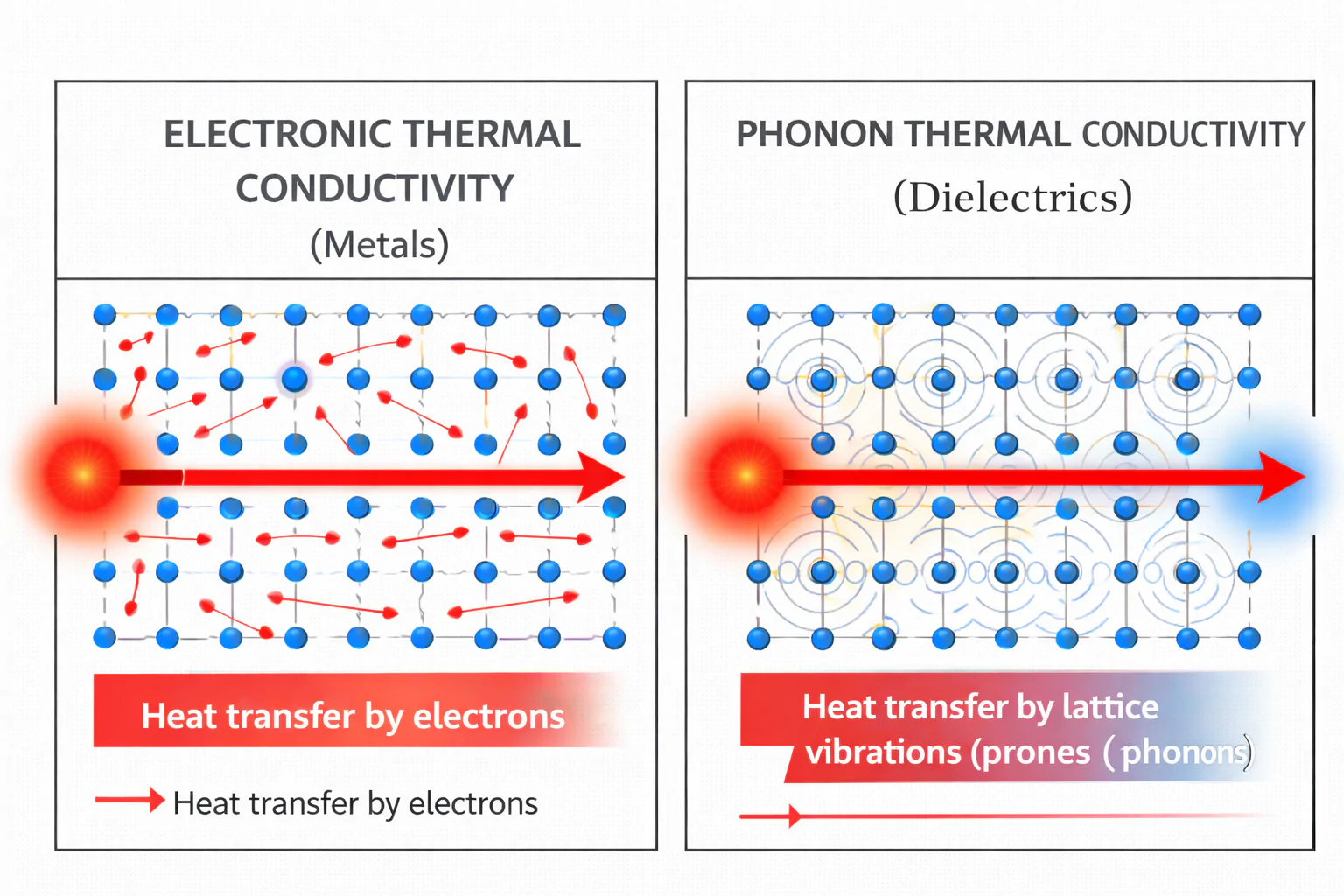
In semiconductors, both mechanisms operate simultaneously. In addition, heat transfer is influenced by impurities, lattice defects, and exciton transport processes.
Thermal Resistance and Debye Temperature
By analogy with electrical resistance (R = 1 / σ), thermophysics introduces the concept of thermal resistance: W = 1 / λ. In crystalline materials, it arises due to phonon scattering by defects and impurities.
Debye temperature (ΘD) is an important characteristic that defines the limiting spectrum of lattice vibrations. For most solids, it lies in the range of 100–400 K, but there are notable exceptions:
- Beryllium: ΘD = 1440 K
- Diamond: ΘD = 2230 K (which is why diamond, although a dielectric, conducts heat better than copper).
Effect of Moisture on Thermal Conductivity
Water conducts heat much better than air. Therefore, moist thermal insulation of a heater sharply loses its insulating properties, leading to increased heat losses and a higher risk of equipment overheating.
Table 1. Thermal Conductivity of Building and Insulating Materials
| Material | Moisture, % | λ, W/(m·K) |
|---|---|---|
| Asbestos board | Dry | 0.157 |
| Concrete (with gravel) | 8 | 1.28 |
| Glass wool | – | 0.035 – 0.081 |
| Granite | – | 3.14 |
| Clay | 15–20 | 0.7 – 0.93 |
| Oak (along the grain) | 6–8 | 0.35 – 0.43 |
| Oak (across the grain) | 6–8 | 0.17 |
| Brick | Dry | 0.67 – 0.87 |
| Polystyrene foam | – | 0.043 – 0.058 |
| Glass | – | 0.74 |
| PTFE (Teflon) | – | 0.233 |
From the data above, it is clear that moisture and material structure can change thermal conductivity by several times. This must be taken into account when selecting insulation.
Wiedemann–Franz Law and Metals
For metals, there is a clear relationship between electrical conductivity and thermal conductivity. According to the Wiedemann–Franz law, at room temperature:
- L — Lorenz constant (2.45 × 10⁻⁸ W·Ω/K²)
- σ — electrical conductivity of the metal
- T — absolute temperature
This explains why copper and silver are efficient conductors of both electricity and heat.
Temperature dependence:
- near T = 0 K: λe ~ T
- in the intermediate range: λe ~ 1 / T2
- at high temperatures (T ≫ ΘD): λe ≈ const
Table 2. Thermal Conductivity of Metals and Alloys (at 20 °C)
| Li | Na | K | Be | Mg | Al | Mo | W | Fe |
| 70 | 140 | 100 | 160 | 172 | 209 | 137 | 169 | 74 |
| Co | Ni | Pt | Cu | Ag | Au | Zn | Cd | Pb |
| 70 | 62 | 70 | 393 | 415 | 312 | 113 | 98 | 35 |
| Brass | Steel | Cast iron | Stainless steel | |||||
| 86 | 45 | 63 | ~15 | |||||
Note: Alloys always have lower thermal conductivity than pure metals. That is why stainless steels are often used for heater sheaths (for example, AISI 304, λ ≈ 15 W/(m·K)) — they combine strength, corrosion resistance, and moderate thermal conductivity.
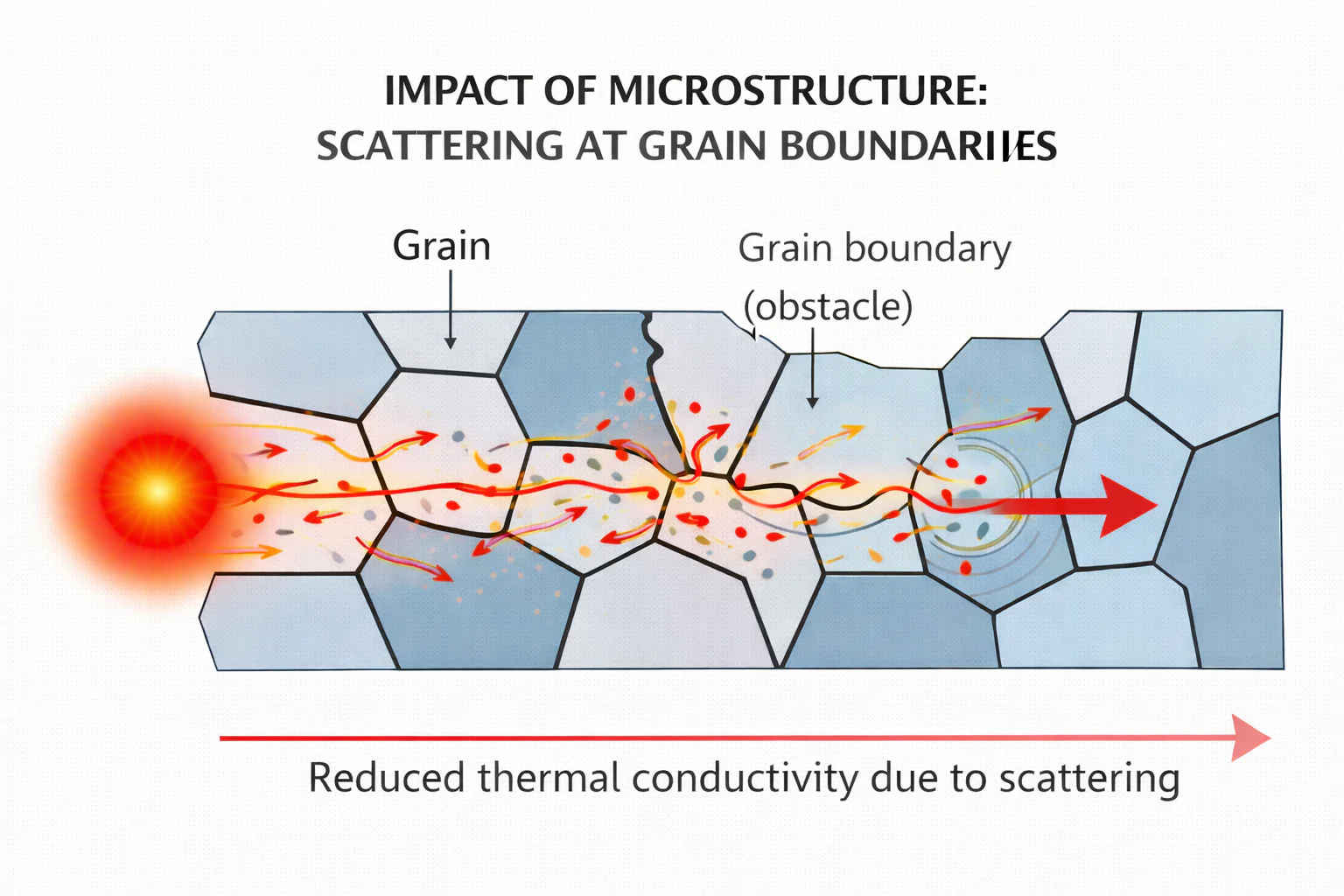
Influence of Material Structure
Thermal conductivity depends on grain size and microstructure: it usually increases with increasing grain size. In solid solutions, thermal conductivity decreases as the composition deviates further from pure components.
Brief Summary
Thermal conductivity of solids is determined not only by the material itself, but also by the heat transfer mechanism, temperature regime, moisture content, and microstructure. Understanding these factors makes it possible to correctly select materials and the design of industrial heaters, increasing their service life and energy efficiency.