


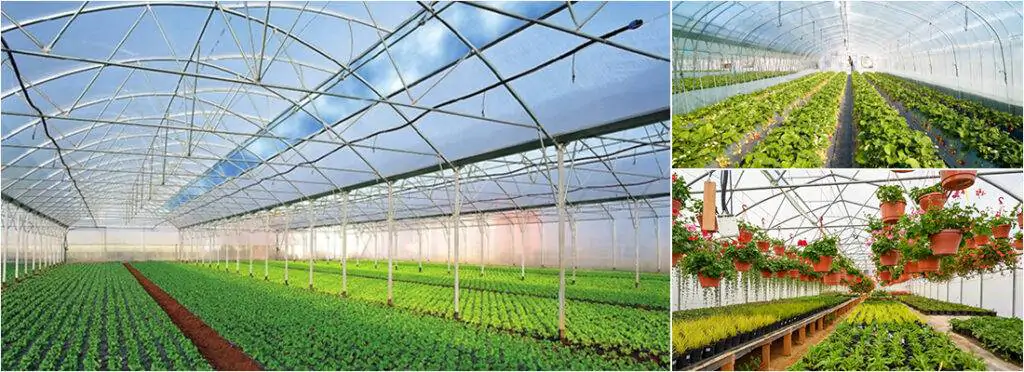
Greenhouses are used everywhere in our country. They help to grow vegetables earlier than the seasonal period, so they are popular both in large agrarian farms and with owners of small land plots. Those who have created entire greenhouse farms grow crops and flowers all year round.
Spring weather is also full of surprises: after a stable warmth thermometer readings can approach zero. Root frost is dangerous. If thousands of young shoots are sown, all the labor will be wasted.
We will tell you what is the value of electric heating and what is offered from the devices.
What are the benefits of heating
Shoots, tubers and seeds get into an environment favorable for development. Warm air and good quality watering help them to gain strength, form ovaries and fruits.
– Depending on the type of crop grown, the optimal microclimate for its ripening can be created.
– In the farm for 2-4 weeks accelerates vegetation.
– Those who are fond of southern crops, the greenhouse will help to grow bananas, oranges, lemons, miniature bush tomatoes, herbs, berries.
Types of greenhouses in constructive design
Let’s consider 6 basic models.
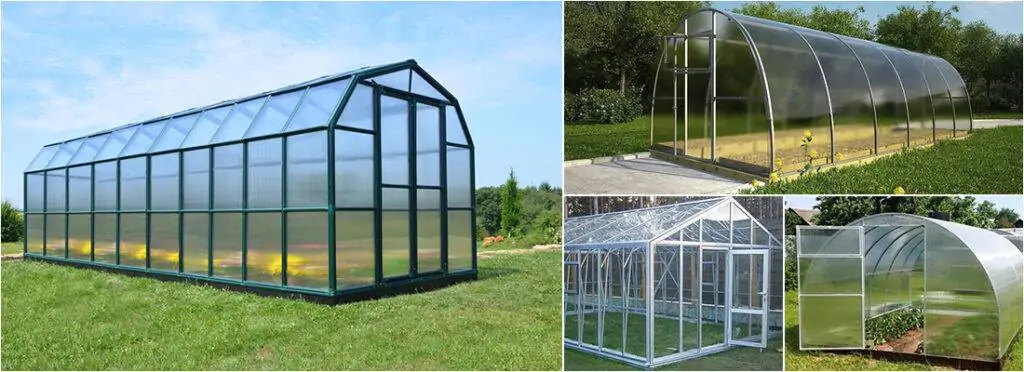
Filmy. On the welded or assembled from metal frame, a dense film is stretched. The disadvantage is the aging of the polymer material and its piercing by falling branches, claws of birds and pets.
Arched (like a greenhouse, but taller). The upper part of them is made symmetrical arc, as a result of which rainwater does not accumulate, but flows down the sides. Convenient mobile version of the design, which can be moved. More capital option – analog with a pitched roof (stationary design needs a strong foundation). Consist of a metal frame and polycarbonate coating
Glass. Convenient in that it is possible to plan the creation of opening sashes. The material transmits sunlight and daylight well. A good option will be double glazing.
Tunnel variant. Analog of the elongated, narrow arched greenhouse, but with a greater height.
Modular designs. Convenient when you need to plant different crops. Such a greenhouse combines several zones connected by passageways.
In case of installing IR heaters, do not forget that heat energy is stored better in conditions of high humidity. Ensure that warm air stays at the bottom of the greenhouse and cool air rises to the ceiling.
What can be used to heat greenhouses
What is better to use to create a microclimate in the greenhouse? Let us describe several methods, each of which has advantages and disadvantages.
1. Gas
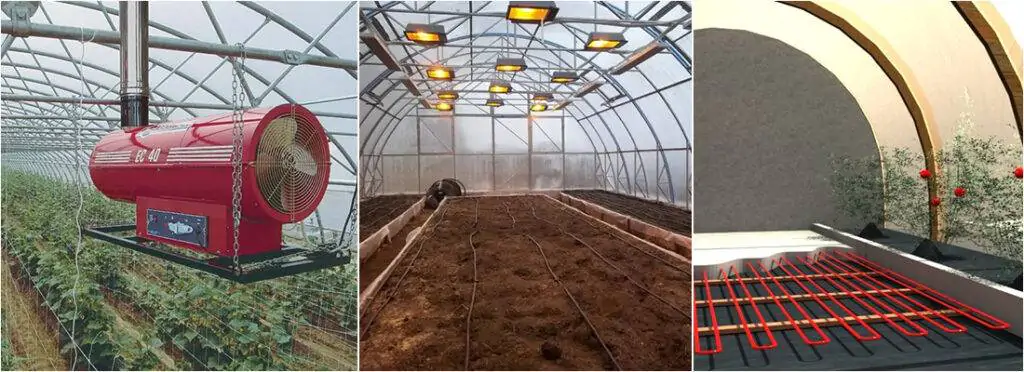
Previously used for a greenhouse, which was attached to a private house, bringing a separate gas circuit to the object. Now it is convenient to place convectors and burners with IR radiation inside. Connection is carried out through a separate channel or using cylinders. Gas burners can be installed in the absence of structural elements made of wood. A supply and exhaust ventilation system must be installed.
2. Biological heating
Manure, straw, peat, sawdust, leaves are introduced into the soil. These materials digest microorganisms, turning them into useful substances. Watering with nitrogen-containing liquids improves the conditions of heat generation. In the course of reactions, heat is released, warming the soil. And it is easier for crops to germinate in a warm environment. This option is used by rural residents, and for large farms use other methods of increasing soil temperature.
3. Water heating
For this task, it is necessary to install a boiler on any fuel, a pipe and a pump for transportation of water on the contour. Communication is laid on the inner contour of the greenhouse, under the racks or the bottom of the excavation. The temperature of the air and the ground is raised at the same time.
4. Air
Organized with heat generators and air tools that do not dry the internal space of greenhouses. The volume of space is quickly heated, which is convenient if the temperature outside has changed dramatically. A perforated tube with a carrier supply heats only the air and the ground stays cool.
5. electric heating
Cables, mats, laid at the bottom of the greenhouse, well warm the root system. Infrared lamps are used for a raised ladder. And if you add a fan, then the local heat supply will turn into heating the entire greenhouse. Ceramic, tubular, finned heaters are suitable for increasing the temperature of the air. They carry away moisture from the air, so it is necessary to provide frequent watering or place inside the greenhouse containers with water.
6. Solar
Equipping the roof of the greenhouse with light-absorbing panels creates a natural source of heat production. Initially, investments are needed, which will gradually pay off in yields.
To determine the method of heating, take into account such factors:
– Climatic nuances of the territory. In northern parts, you need to pay more attention to the covering material of the greenhouse.
– The purpose of cultivation. If the structure is made for your own needs, you should not buy expensive systems. Those for whom it is a business, you need to stop at the optimal heating system for specific conditions.
– Financing. Choose what is affordable (including purchase and installation).
– Dimensions of the greenhouse. The larger it is, the more powerful equipment you have to buy.
When the same type of crops are grown in a greenhouse, you can create conditions that are close to ideal.
Why electric greenhouse heating is considered more favorable than other options
The electric option has many advantages over other analogs.
Quick installation at the right height, connection to the network ̶ that’s all the activation.
- No need for a place to save firewood, pipes for water, gas or oil supply.
- No exhaust fumes or exhaust systems.
- Safety is ensured at the time of installation: earthing of the devices is done.
- Versatility. Electric heating is used for greenhouses with any plantings, it is suitable for all types of structural solutions.
- Promptness of heating. In the first seconds after turning on the equipment, heat begins to flow.
- No energy losses, which is inevitable when introducing solutions with fuel combustion.
- No need for cleaning and frequent replacement of rotating components. This reduces operating costs.
- Quality of operation. Electric appliances evenly distribute heat and ensure that the desired thermal level is achieved.
- Purchase Price. The cost is less compared to gas systems.
Quick, convenient, low-cost. This is how electric equipment for heating greenhouses is characterized, which is chosen for years.
Common electric heaters for greenhouses
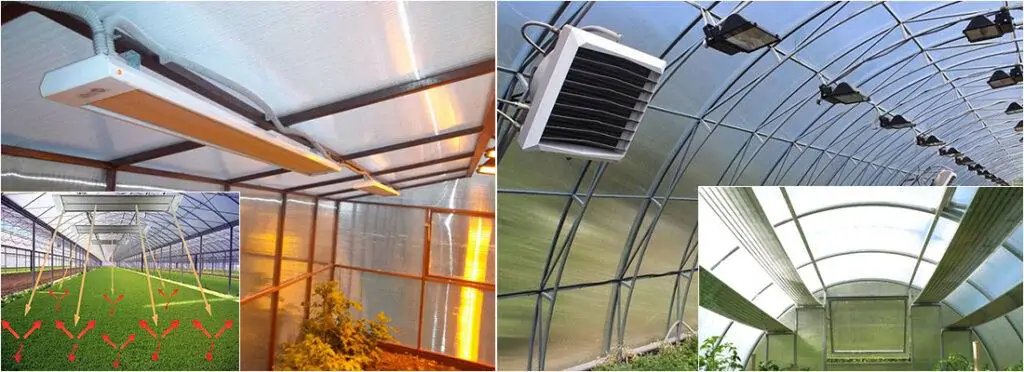
We have found that mains-powered heaters are a sensible solution in terms of financial investment, speed of temperature rise and thermal performance.
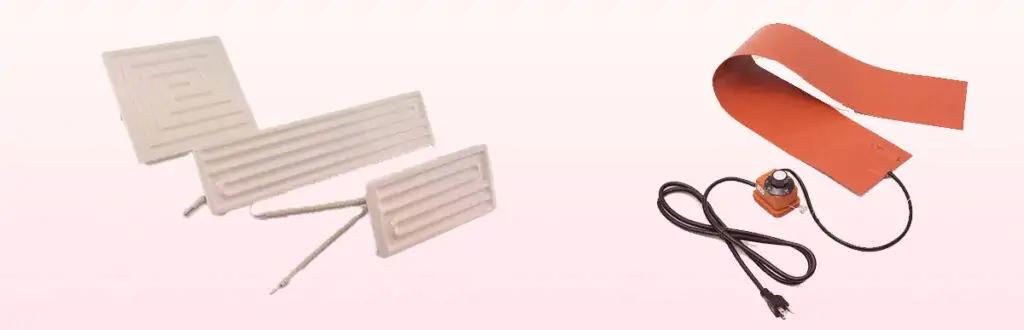
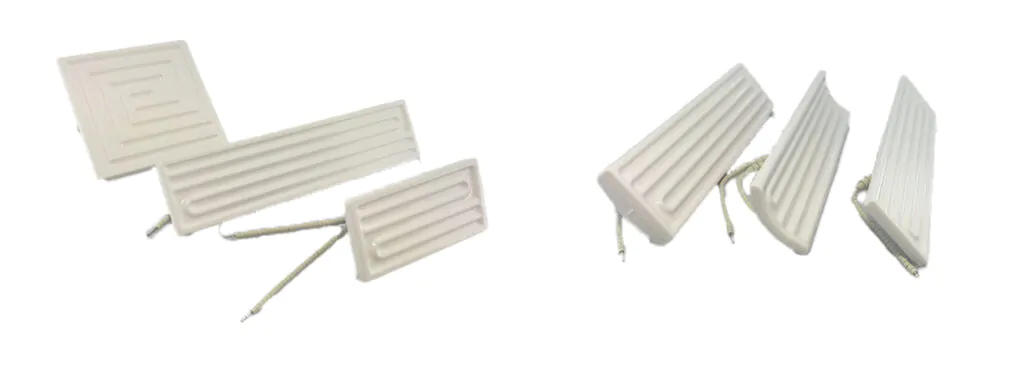
Ceramic infrared heaters
“Mini sun” in the greenhouse gives warm, penetrating rays. It does not warm the air, but goes straight to the growing shoots. The heat produced in an ecological way creates an environment similar to that of nature. There is a thermostat in the design: it regulates the operation of IR panels and does not allow exceeding the set temperature limit. Products do not dry the air, static mode eliminates the circulation of dust accumulations in the greenhouse.
Installation of sensors allows you to perform zoning. In a large space it is possible to grow early and late varieties, cold-resistant and heat-loving crops. Radiation has an antibactericidal effect, preventing the appearance of bacteria and rot.
When choosing, take into account what the installation will be: stationary or mobile. Prevails ceiling installation scheme, but you can use vertical panels placed, under the windows of the greenhouse, or suspended structures on clamps. The rear part of the devices is not heated, so they can come into contact with any materials. Fire safety is ensured by reliable insulation of the equipment.
It is desirable to purchase IR emitters with a wide thermal range. They are installed at least 1 m from the ground, in large greenhouses this distance is increased to 2-3m. It is necessary to take into account the diameter of ray dispersion to ensure uniformity of heating of the entire green area. This is important when calculating the number of heaters to be purchased. If the heater is initially located 1 meter from the ground, as the crops grow, the intensity of heat supply should be reduced.
Modern IR heating systems with temperature sensors and visual warning systems about malfunctions cost a lot. But in 2-3 years they pay back the investments made. To correctly determine the number of heaters, the power of devices and the step of their placement, contact Intmax.
Flexible IR heaters
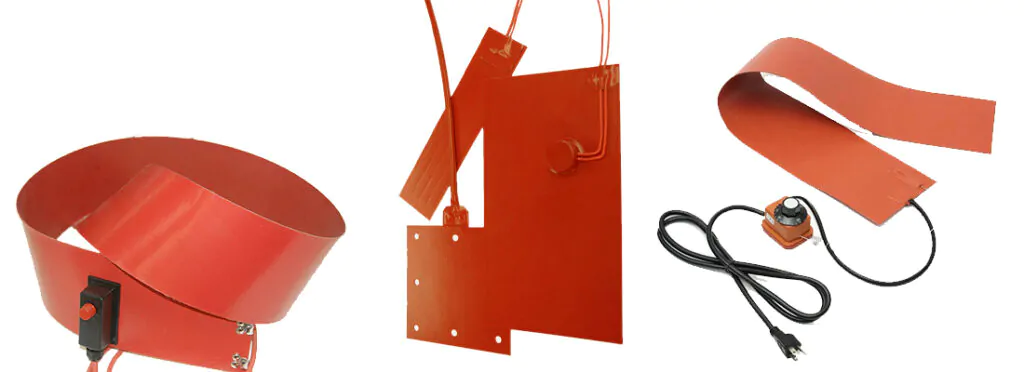
When you need to warm the soil in the greenhouse, you choose flexible heating devices. Cables, strip heaters are designed to be placed on the ground. For year-round greenhouses it is necessary to organize additional air heating.
Such systems are convenient with their bendability, as they can be placed on the perimeter of any shape. The transformation of electrical energy into thermal energy is ahead of other types of heating in terms of efficiency and cost savings. The lack of emissions is good for plants and negates the problems of venting combustion products as one has to do with gas.
Electric heaters are affordable and do not require any special expertise. It is enough to carefully study the instructions, understand the correctness of laying, orient with the place of connection – and you can do everything with your own hands, without professional tools.
A useful option is the adjustment of power values and the duration of heating activation. Flexible heaters are not subject to mechanical stress, abrasion, so there is nothing to break. This results in long-lasting functionality of the cable and strip heating system.
Evaluating factors before buying
When a lot of information about greenhouse heating methods has been gathered, you need to organize it so that there is no chaos in your head. When selecting a system, consider cost, installation costs, frequency of maintenance and repair. Take into account the characteristics of heating, operating costs, the result of the impact on vegetation, the payback period of the investment. Let’s give advice on efficiency: first place goes to IR devices placed in the ceiling area. Second place is awarded to flexible ground systems and films. Third place – calorifiers, convectors, fourth – tubular systems with a heat carrier in the form of water, steam, gas.
In some cases, it is appropriate to use combined heating of greenhouses, combining heat treatment of the ground with energy supply to the air or vegetation. Thanks to greenhouse heating, seasonal vegetables, mushrooms, berries are brought to stores year-round, so that people do not deny themselves the pleasure of buying their favorite products at any time.
Order heaters for greenhouses at a good price
“Intmax” is part of a group of leading manufacturing companies in Ukraine. We are the owners of technological facilities, where we manufacture to order a large range of products. We conduct in our own laboratory experiments with new developments, improving their operating parameters.
We perform individual calculations for the manufacture of products. We produce tubular, flexible and ceramic infrared heaters used to change the temperature of the air and soil.
We show attention to each customer, focusing on his needs. We produce a line of products that are tested for quality of manufacture and compliance with the necessary parameters. Each product has a warranty period, safe when used properly. Our prices – one of the lowest in the Ukrainian market. Always ready to consult on the use of products and give sound advice.